Showing posts with label Artaud. Show all posts

Tuesday, 12 December 2017

Artaud - Part 5

Lesson: Thursday 7th December 2017

Initial Ideas

For the past few weeks, we have been creating Artaud style monologues, duologues, and group work. Myself and Izzy decided to create an Artaud style duologue based on mental health because of Artaud's time spent in various mental institutions that provided the basis for much of his work. With additional research we found that Artaud had 52 rounds of electro-convulsive therapy which may have also impacted on his work, hence why we decided to include a section showing ECT (or thereabouts) in the piece. Moreover, I pulled inspiration from a GCSE Artaud piece I saw in Y10 where they said something along the lines of "At 11pm I will slit my wrists. At 12pm I kill myself" which I thought was really effective and allowed for more mental health type issues to be seen.

Our initial idea was to have two opposing personalities inside the same person's head, something which becomes evident at the end of the piece, and for the audience to see a 'typical' day in the life of this person (inspiration of "a day in the life" taken from GCSE criteria and from The Beatles song "Day in the Life"). We decided to have little to no speech so that we could focus on the stylised movement element of the piece, although the words and phrases that we did use, as I will explain in the performance analysis below, were effective and not overused.

We decided to use a traverse stage and have the audience members standing up so that they would become uncomfortable physically within the piece. Our initial idea was to have an in the round stage with people stood up, however, we thought that not everyone would be able to see the action on stage and miss vital parts of the piece. A traverse stage allowed the audience to see all the key parts within the piece and allowed for the filming of the piece to be much easier.   

Performance


Entrance - 0:00 - 1:04

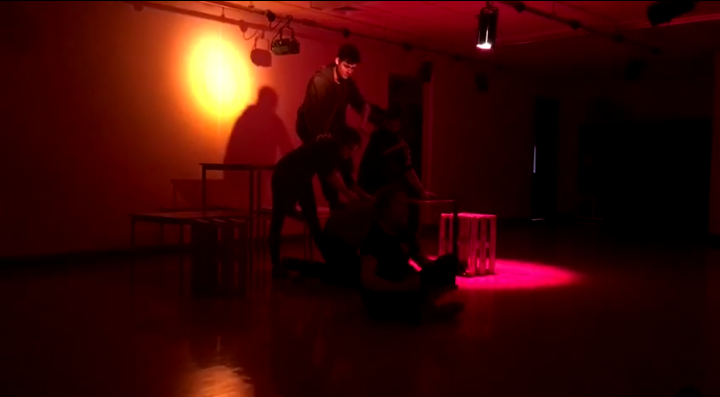
At the beginning of the piece we had the audience stand outside so that we could bring them into the performance space. We did this so that the atmosphere would be immediately made tense, which was enhanced by our stoic, emotionless faces. We wanted the audience to hold hands so that they feel somewhat comfortable when they initially enter the space which would contrast with the loss of comfort and touch after we split their hands later in the piece which allows for more uncomfortableness. One thing that we needed to be more aware of was the amount of people in the audience and who we were bringing to which line. This was brought to light when we accidentally forgot to add Miss Starbuck to a line, which I then had to go out of my way to rectify by going to the end of the line to connect her hand to Joel's. After linking the audience's hands outside the performance space, we brought them into the space and set them up as a traverse stage. Another slight negative of this was that the audience clumped together and didn't immediately go into the lines that we wanted. We had to spend a few seconds spreading them out which we didn't expect when we first came up with the traverse stage idea.

Our initial idea for this scene, when we had the audience in the round was that they'd already be stood in the circle and have myself and Izzy not in the room. This would have allowed for more tension within the beginning of the piece but the logistical side of how we would get them in the standing in the circle in the first place would have proven to be an issue. I think that the traverse stage was the best way to stage this piece because it was easier to bring the audience into the space and also meant that they could see the other people's emotions in the other line opposite them.

Stylised Movement - 1:04 - 1:44

We used ideas from the Frantic Assembly workshop that I went to in the summer. We used the idea of hands following one another because it shows that the character's are connected in some way as they appear to be mirror images. This was the starting point for the whole piece when we first began to devise it. The grabbing of my head by Izzy and the subsequent rolling and stomping shows the conflict between the two states of mind and also shows that Izzy's character is more in control than the state in which my character is in. The lift that we use when I 'ran' in mid air could show my character/state of mind trying to break free from the control of Izzy and her state of mind. As I am on Izzy's back and being restrained on her back, this could show that Izzy is again much more in control that my character is at this point in the piece. When we both bang our heads, this is trying to hint to the audience that the whole piece is taking place in someone's mind and that they are struggling with the two contrasting personalities/characters that are present in their mind. It could also show that the two characters are destroying the mind in their struggle for control. When I drop to the floor, I think that this could show the start of Izzy slowly losing control of the host mind and that I am beginning to the main personality within the mind. However, Izzy gains back this control when she pulls me into the middle of the stage.

Waking up - 1:44 - 2:10

This is the first section in which we use words which makes the scene have much more of an impact. Izzy's tone initially is a happy and soothing one which may make the audience think that the scene is getting somewhat less cruel, especially as Izzy comes to touch my face lovingly. This is immediately contrasted when she shouts in my face which is the only loud thing that we had in the piece thus far. The puppet like movement after shows that Izzy is still in control of the mind and of my character which is why I 'wake up' as Izzy instructed. I think that this could also show the mind set of people with a mental illness such as depression whereby they struggle to get out of bed or find anything that spurs them to do something.

Going to work - 2:10 - 2:56

Initially for this section of the piece, I was going to sit on Izzy's back and pretend to be working. This links back to or first Artaud lesson when we gave everyday objects the ability to speak. However, this wouldn't have achieved the same effect as Izzy's screaming and also seems natural (whereas Theater of Cruelty is very unnatural). The contrasts of my "bored" 's to Izzy's screaming is great, and shows how the person may feel on the inside but hides their emotions on the outside. This is why when Izzy is screaming and using physical movements, she can't touch me and is acting as though there is an invisible box around me. I tried to make my "bored" 's in time with the clock ticking sound effect so that is shows just how slowly the time at work is going. As Izzy collapses at the end of this scene, the power is seen to be shifted from Izzy to myself, something which can be seen in the next scene when I'm the one that  introduces the next part of the day. We are on opposite sides of the stage in this scene so that both sides of the audience have access to an important part of the performance due to the aforementioned shift in power.

Going to therapy - 2:56 - 3:48

This section alludes to what I mentioned before about Artaud's ECT. In some ways this could link to Anatomy of a Suicide due to the ECT scene in Anna's story. Before the piece I forgot to put a pen on the floor that I should have used to poke members of the audience to see if they'd react to the ECT in the way that Izzy would. Instead, I had to touch members of the audience which in some ways was creepier than if I had poked them with a pen which they may have reacted to by flinching which wasn't the action that we wanted.

Stylised Movement 2 - 3:48 - 4:24

We did another physical movement scene here to initially show the effects of the ECT but it then developed into the same section from the physical sequence before, showing that again the two states of mind were fighting for control. During this sequence we did the running action again but this time both of us were doing the action because it showed that we both couldn't run from the mental illness that was ravaging the mind. We pulled from Brechtian influences here with the silent scream which is from "Mother Courage and her Children" but this can be turned into Artaud as shown here due to the use of exaggerated facial expressions, again linking back to the first Artaud lesson. When we ran to the edge of the traverse stage and were pulled back, this represented how we couldn't escape from the mind during waking hours and were pulled back into the repetitive fight for control. The repetition of this section and indeed the whole idea of having a day in the life, could suggest ritual, an Artaudian technique.

Dreamscape - 4:24 - 5:18

We used a dreamscape here to contrast between the harshness of everyday to the relief that dreams and sleep provide from society and world news. We deliberately changed our demeanor from a bored, sullen, blank feel, to a happy yet dreamy tone to highlight this. I think what made this section more uncomfortable was that we touched the audience members faces. This was to show that dreams are much more caring and could link to how Izzy was going to stroke my face in the waking up scene which could be a remnant of the dream state that happens every day. One thing that was an issue in this section was when we tried to disconnect the audience's members hands. We did this to show that dreams allow people to feel safe, however, many of the audience members were gripping onto each other's hands quite tightly which meant that it was difficult to separate them. I again used inspiration from GCSE when we went to the doors to escape from the dreamscape and from life (in the GCSE piece that I saw the actors shouted whilst banging on a door "Let me out! I don't want to be a part of this exam anymore!" which allowed for a stilted feel to the piece, anyway, I digress). I think that this was effective because audience members may think that the performance is over but may be shocked when we start screaming and creating a small soundscape. When this happens, we were trying to show that dreams aren't something that people can escape with as they will ultimately end and leave the person stuck in the real, dreamless world.

Death - 5:18 - 5:52

This is the key moment where the audience realise that myself and Izzy are the same person as we say the same words, kill each other and die at the same time. The phrase "At 12pm I kill myself" is quite a shocking thing to hear, as the words that we've said so far had been quite tame and didn't allude to this ending.


Props

During this performance we didn't use any props, but during rehearsals and during the piece, I was meant to use a pen for the ECT so that myself and Izzy had something to grab during the following stylised movement sequence.

Sound


The soundscape above is the one that we used throughout the piece. We started off with the clock ticking and then moved onto the slowed down music which then stopped after the end of the dreamscape. By using a soundscape we made the audience feel more uncomfortable and on edge from the beginning of the piece. 


Lighting

The lighting initially was quite dim with only a thin strip in the middle of the space being lit. This was to show how trapped and restricted the mind may feel by reality. In contrast, during  the dreamscape, the light became lighter which showed how much freer the mind feels in dreams as there are no responsibilities to be faced.

Saturday, 2 December 2017

Artaud - Part 4

Lesson: Thursday 23rd November 2017

In this session, we performed our final group Artaud pieces after making a few corrections to the pieces, improving parts, and adding parts.


Scenes
Entrances - 0:00 - 2:26
Freeze Frames - 2:26 - 3:50
Assaulting the Audience - 3:50 - 4:50
Ending - 4:50 - 6:01

Entrances - 0:00 - 2:26

At 0:00 - 0:19 Joel brought the audience into the space. The room was fairly dark, apart from the light of the torch that Joel was holding, which meant that the audience couldn't really see what was going on, only that there were shadows coming from the usage of the torch. This allowed for an element of surprise within the piece and meant that the audience were on edge somewhat from the beginning of the piece. From the limited amount that they could see, they could see that only two actors were visible which allowed for more suspense when they realised that the other three actors were missing as they already know that the other actors are part of the group. Moreover, the lack of music in this section made every small movement and small sound much more noticeable which allowed for a tense atmosphere. Furthermore, as Joel shined the torch in the audience's faces it made them feel like a suspect and uncomfortable before the piece has even begun.

At 0:50, the audience's focus is drawn to Kathryn which is done with the torch. Her position on the ground is a vulnerable, open one which makes her murder by Joel more serious. Much like with Kathryn, the attention is switched to the knife when it is lit by the torch as it glints in the light. This allowed the audience to understand easier what was about to occur. When Joel does murder Kathryn, the change of light is more noticeable because it is the first technological change in the piece thus far. The light changed from a white "innocent" light to a red "angry" light which could show the understanding of the Young Girl and Young Man's relationship because the two at first appear to be in love which is innocent and seems to be allowed by the audience. However, when the audience discover that their love is somewhat incestual, the love is not as accepted by the audience which may provoke a strong response to the script such as anger suggested by the red light. The red light also serves a much simpler purpose to show that Kathryn has been killed. Joel puts the knife into Kathryn's hands which could show that Kathryn is now the one who's in control of what is happening on stage in order to found out who had killed her and why they had done that, as shown by the line that is said later in the piece - "Tell me how it happened." This suggestion could make the line "Leave me alone God" imply that Kathryn is shunning God so that she can find out how she has been killed, which is then granted to her by God in the line "Tell me how it happened" in which she could be appealing to God to show her how she died.

At 1:15 Joel bangs on the door. This is the first loud noise in the piece which could shock the audience and set them on edge more so. Additionally, this served a practical purpose because it allowed myself and Lauren to enter the stage at the same time. We were both in sync (for example walking and sitting down) which made our movements creepier to the audience. As we both entered from opposite sides of the stage, some audience members didn't notice either one of us which made the shock of when they saw the other person, to be more prevalent.

One positive of this section is that every noise could startle due to the tense quiet atmosphere. Additionally, the lighting was well thought out as to when to change the lights so that they could make the biggest impact upon the audience. A negative of this section was that the entrances was slightly prolonged and could have been made shorter. However, this prolonged entrance tests the audience in a new way because they are forced to watch action that is really small and slow which assaults the audience in a different way.

Freeze Frames - 2:26 - 3:50

We made an improvement from last time on this section of the piece as the lights were now on for much longer during the freeze frames which allowed them to be visible to the audience (and the camera) for longer. The slight movement after each scrape of the knife/light change could make the audience question their own memory of what they had seen in the previous freeze frame. The lack of music/sound effects until after we banged on the risers, made a small soundscape and also allowed the audience to focus on the movements of the scene. The sudden noise after a prolonged silence assaults the audience's senses. Something that was totally coincidental was the ringing sound of the risers after we have finished making noise from them. This was effective because it easily flowed into the music.

Assaulting the Audience - 3:50 - 4:50

At 4:07 we use the phrase "I love you and everything is beautiful" which are specific words from the play "Spurt of Blood" that still allowed us to present the storyline. It may be difficult to see, but at this point we go to the audience and physically 'assault' them by touching them and stroking their faces. We could have done this for longer to prolong the audience's uncomfortableness. Eventually, we all get to saying the phrase together monotonously which could show how the Young Girl may be being manipulated by the Young Man because of the repetition from the both of them as shown here.

At 4:33 we again use a phrase from the play - "Bitch! Look at your body!". There is a contrast here from the slow movements that we have been showing before, to the sudden, quick jolt upwards just before we say the line, showing a change of pace. This quote from the play was said quite loud which again contrasts with the relative quiet from before, which adds to the assault on the audience.

 At 4:46, we pull the crates out from under the chairs of various audience members. We made an improvement from the last time that we performed the piece as we used three crates spread throughout the audience instead of a singular crate in the middle of the audience. This meant that all of the audience was included and made all of their experiences of the piece relatively similar. However, it was hard to get the slam of all three crates on time, largely because the audience's clothes and legs got caught on the crates. This part of the piece was overall effective because of the assault on the audience because they didn't know who was touching them because of the darkness of the room.

Ending - 4:50 - 6:01

At 4:52 we use the quote "Leave me alone God". It is clear to hear heavy breathing from all actors which created a small soundscape. The quote that we used was again from "Spurt of Blood" by Artaud which emphasised part of the script making it seem more important. We also used inspiration from an Anatomy of a Suicide lesson when we did the Physical Essay work where we restrained people and they tried to get to the other side of the room. In this piece, we restrained Kathryn which made the other actors God because Kathryn says the aforementioned line. The light change after Kathryn says this line, represents the huge spurt of blood that is given in the stage directions; this stage direction is also seen by myself, Lauren, Maya, and Joel slowly leaning back. This juxtaposes the quick action from before which messes with the pace and makes the piece almost jolty which could suggest some form of stylised movements.

At 5:04 we again used an extract from the script - "Tell me how it happened." This links back to the beginning of the piece where we showed Kathryn being murdered by Joel as Kathryn's character could be asking how she was killed. The shadow image that we created answers the demand of Kathryn's character.

At 5:30 we used a walking lift to show the anger that Kathryn's character had towards Joel. It could have looked more effective if we had thought to use the shadow of it to hit the back wall, in order to create more shadow images. The lights showed the mechanics of the lift rather than the impressive movement of the lift itself. At 5:44, after we have put Maya on the ground, the music stops and we look at the audience; this is not visible on the recording because of the lack of light.

 Overall, I think that this was an effective piece but we could have thought more about costume and make up so that we all matched and so that we would have assaulted the audience's senses more.

Sunday, 19 November 2017

Artaud - Part 3

Lesson - Thursday 16th November 2017

During this lesson and after school on Wednesday we adapted our previous piece by using the ideas and freeze frames that we had before into a longer performance. Unfortunately the video that we got from the performance is very dark and is not that easy to see what is happening from it. When we next work on the piece, I think that we should make the light a tad brighter enough so that the audience (and camera) can see what is happening but not so much that the effect that we were trying to achieve isn't lost.

Instead of dragging a piece of set on stage, we decided to use a knife being scraped on a riser to create the same sound effect. This allows the knife to become part of the set which allows us to use it as part of the set for the rest of the piece and also creates a small soundscape which we will be able to expand upon at a later date. This scraping can be seen from the beginning of the piece which immediately assaults the audience's senses.  The images between each scrape can't really be seen as the lights are on for a too short amount of time and because of how dim the lights are. I used the idea of things moving when you can't see them from the Weeping Angels from Doctor Who.

At 1.00 the relatively quiet scraping is contrasted by the banging of risers. We did this to try and show the earthquake that takes place during the play (Spurt/Jet of Blood). The contrast in volume assaults the audience's sense again and shocks them somewhat. As I was watching the video and making notes, I myself jumped from the volume of the soundscape, even though I knew what was going to happen. After this, quieter music came on which again contrasted with the banging from before and also showed an additional Artaudian technique of using technology. Instead of music, we could add in some humming from actors to further assault the audience's senses.

At 1.07 we try and interact with the audience but this can't be seen, again due to the darkness of the lights. We could make the lights stay on during this part of the piece but at  dim level so that the effect would be kept and the audience can see the shapes of the actors as they come towards them.

At 1.19 we used the phrase "I love you and everything is beautiful" which is taken directly from the play. The murmuring of this line worked well because it seemed as though the 'characters' didn't believe what they were saying, which could show how the Young Girl may be being manipulated by the Young Man in the piece. We also touched various audience members to 'freak' them out; at this point the lack of light worked well because the audience's members don't know who's touching them. In order to make this part more effective, the lights could be turned to full brightness as we make our way towards the audience and then brought down to dim as we make our way over to them. This would allows the audience to see the action on stage and still keep the desired effect.


At 1.29, we can't see the image that we made due to the lack of light again. The image opposite is what we were trying to create. We wanted to create an image that would also project somewhat onto the back wall behind us using shadows. Although this can't be seen on this image, I think that the connections between all the actors suggests an implication within the play. It is implied by the Bawd and the Knight that the Young Man and Young Girl are related, which alongside the line "You love me and everything is beautiful" suggest that this is what this image is trying to show the audience.

At 1.47 it is clear to hear an audience member being 'freaked' out and 'assaulted' by her voice and screams. This is how we know that what we're doing is effective because it had the desired reaction from an audience member that we wanted. However, we only touched and 'attacked' one audience member which left others wondering what was going on in the piece. Maybe if we moved the audience together a bit more instead of spacing them out as far as we did, then all the audience members would be able to experience what was going on in the piece.

At 2.27, courtesy of Lauren, there was a shrill scream which shocked and assaulted the audience. I think that the piece needs to have more random screams throughout it and maybe some manic laughter to make the audience feel more uncomfortable.

There were many positives to this piece which was mainly due to the audience vocalising their uncomfortableness, which was the desired effect that we were searching for. We also used some form of soundscape and dreamscape as well as some stylised movement, especially in the image above.

However, some of the audience weren't involved which can easily be solved by moving the audience closer together which may help in making them feel uncomfortable. The obvious negative is the lighting which meant that the camera didn't pick up the entire piece properly which can be solved by brightening up the lighting. Also, I think that we should add a section of stylised movement and another of some form of humming in order to create visual poetry and more soundscape.


Friday, 17 November 2017

Artaud - Part 2

Lesson: Thursday 9th November 2017

In this lesson, we worked on the script Jet/Spurt of Blood by Antonin Artaud. It was written in January 1924 and as it is only 3 pages long, could have been completed in one day. It is vastly surreal and most definitely follows the 'criteria' for Theatre of Cruelty due to its outlandish stage directions and general horrible subjects.

This was the first time that I had encountered the play and had many first impressions on the script. I was very shocked at what is in the play as it is very graphic and included lots of things that many people wouldn't be comfortable speaking in public about. This is very much an Artaudian technique because Artaud wanted the audience to be shocked and confused by what is happening on stage.

The first part of the script says something along the lines of "I/You love you/me and everything is beautiful" which is a conversation which is happening between a Young Man and Young Girl. Even the character names could set an edge of shock to the actors (as Artaud wanted to be cruel to both the actors and the audience) as Young Man implies that the character is much older then the Young Girl. This could imply an abusive relationship whereby the Young Girl is being manipulated into thinking that she is in love with the Young Man. I thought that this part could be acted whereby the Young Man and Young Girl are facing each other fairly close but don't seem to put much emotion into their voices and not touching each other. they should still follow the different pitches of voice that are suggested in the script, but these should be done with little emotion. I think that this should be done like this to show that the characters are somewhat uncomfortable with what they're saying which would also make the audience uncomfortable due to the obvious difference in ages. I think that at this point, Artaud may be mocking young love and how it can often be manipulative and not worth people's time.

When the hurricane sequence ends I think that everything that falls from the hurricane should remain on stage which may attack the audience's senses, especially if the objects land in the audience.

I also noticed that the stage directions are very detailed in some places which is very appealing when looking from a directing point of view. Some of the stage directions are very graphic such as the part where scorpions begin to crawl out of a character's dress. This may shock the audience, actors, and especially the director who would have to find a way to effectively portray what Artaud wanted to achieve from the piece. I think that when the scorpions crawl from the character's dress and then transfer to the Knight that this could resemble the spread of an STD. This can be supported as the play is set on the streets near a brothel whereby both parties may have had sex with prostitutes and as it is implied that the two are married so may have regular sex where they could have spread the STD. Linking to the stage directions, the amount of tech that is involved in the stage directions create a dreamscape which can further confuse the audience's senses and shows an Artaudian technique.

We were then given a choice between developing the script by using either props or set, with tech being used in each. I chose to use set because I thought that interesting soundscapes could be used with the set as well as more interesting shapes. Additionally, I thought that props would make the piece too realistic if too many were used within the piece. Below is the piece that we created:


Initially, we tried to follow the script which resulted in us not being able to sustain a piece or create a piece that seemed Artaudian enough. I think that we should have started by creating freeze frames and having a small discussion before attempting to make a scene rather than starting initially with something that seemed as though it was more natural than surreal.

Eventually we created some freeze frames that we thought signified the major parts within the script which allowed for more effective use of Artaudian techniques.

The first freeze frame that we created was the one opposite. This shows the Young Man and Young Girl who are gripping onto each other, which shows their 'love' for one another that they declare. Myself and Lauren are reaching through the bottom of the riser which could have been slightly discomforting for the audience - this however, was not that effective because we didn't actually go into the audience to interact with them.


 The second freeze frame that we created was the one opposite. This shows the part in the play where the Bawd's hair is gripped by God. I wanted to make a giant hand like was said in the script, but by using our bodies and contorting them in such away that was both disturbing and able to create a hand. Instead, we simply put a hand on the Bawd's head which I don't think was as effective.


 The final freeze frame that we created is the one opposite. This shows the fury of God after the Bawd bites His hand. We used the risers to show how much taller God would be over the rest of the characters. Initially we wanted to lift Joel up and have him suspended in the air to show how impressive God was, but found this to be difficult. However, with multiple bodies being lower than him, it seemed as though he was much taller than the other actors.

There are positives about this piece. For example, the use of soundscape at the beginning of the performance with the use of the set by dragging it along the floor attacked the audience's senses slightly, but not enough to make it cruel to them. Additionally, the lighting was in some places effective such as the use of the light to create the image of the moon in the first part of the piece. However, the performance was quite dark which although can be effective at some points, sometimes blocked the action from some people's perspective. Despite this, I thought that this was a good first attempt to combat the script but when we adapt the piece even more, I think that we will incorporate more Artaudian techniques to make the piece more effective.

Sunday, 29 October 2017

Artaud - Part 1

Lesson: 26th October 2017

For the next few weeks, we are going to be looking at another practitioner, Artaud, in Miss Starbuck's lessons. Artaud was a French dramatist who worked at around the same time as Brecht. He, however, took a different route to Brecht, and in some ways was somewhat similar to Stanislavski, because he wanted the audience to become emotional when watching a piece, although, Artaud wanted the audience to look into their fears, rather than get lost into the piece that they were watching. Artaud presented the Theatre of Cruelty where he wanted the audience to experience discomfort/confusion about the piece that they were watching. In many of Artaud's pieces, there was no storyline, but rather a theme that ran throughout, which is similar to the political themes presented in Brechtian theatre. His pieces would have minimal dialogue, instead animalistic noises - such as grunts and screams - were used to present the story. He was heavily influenced by surrealism due to a life long addiction to opiates such as heroin. Additionally, he had spells inside mental institutions which also influenced his work.


 He was born on the 4th September 1896 and at 5 had suffered a near fatal attack of meningitis, the effects of which remained with him throughout his life such as emotional and neurological problems. In his teens, he suffered from sharp head pains which also continued throughout his life. In 1914, Artaud was a victim of neurasthenia which is an ill defined medical condition that is associated with emotional disturbance, which was prominent throughout Artaud's life. He was treated in a rest home, but the following year was given opiates whereby he became addicted. Despite joining the army in 1916, he was released a year later due to mental instability and the acquired drug addiction.

In 1918 he committed himself to a clinic in Switzerland where he remained until 1920. After this he went immediately to Paris with medical support, where he studied with Charles Dullin, an actor and director. Artaud found jobs as a stage and screen actor as well as set and costume designer for Dullin. One of the first films that he appeared in in 1924 was Surcourt - le roi des corsairs (Overrun - The King of the Corsairs). He became more interested in the surrealism movement headed by André Breton and in 1923 published a volume of symbolic verse inspired by Breton and others. However, he broke away from the movement when Breton converted to Communism and tried to get the rest of the movement to follow him. despite this, Artaud wrote the film script for La Coquille et le clergyman (The Shell and the Clergyman) which is the most famous surrealist film made.

Artaud was also a producer and in 1927 founded the Théatre Alfred Jarvy with two others, although the theatre had no permeant home. As a producer he learned the practical aspect of theatre, with which he was not happy so when he saw a Balinese drama at the French Colonial Exposition in Paris which was the ideal that he had been searching for because it showed a spectacle and dance.

He was also a theoretician and in 1932-1933 wrote the  Manifestos of the Theatre of Cruelty which is the basis for much of his style of theatre. The first play that he wrote Les Cenci (The Cenci) was a complete failure and sent him to Mexico in 1930. On his return to Paris, he was engaged and had tried to end his drug addiction. In a lecture in Brussels in 1937 he was completely out of control. Similarly, in Ireland in the autumn of the same year he was declared mentally unfit and send back to France in a straight jacket. During this time, Artaud wrote The Theatre and its Double. After this, Artaud was diagnosed as a schizophrenic and spent the following nine years in various mental institutions and eventually died of cancer in 1948.

Despite having no success with his endeavors and his reputation being wholly based on his critical work, he still became a strong influence. He said that in theatre, the spectacle should play the main role and made producers more aware of their elaborate sets, movement, and attention to myth.

Visual Poetry - Instead of words, Artaud used stylised movement, gesture, dance, music, and sound effects to communicate with the audience.

Dream World - Combined with visual poetry, Artaud used symbolic props and costumes in order to affect the audience's emotion and subconscious.

Assaulting the Audience - Lights, music, sound, and images were used to shock and confront the audience; this has been made easier in recent years due to the development of technology.

Involving the Audience - The action would take place around the audience which would allow them to be closer and more a part of the action; in some Artaud inspired pieces (and in my GCSE Drama devised piece) actors can go into the audience in order to affect them emotionally.

Deliberate Cruelty - This is an attack on the audience's emotions and senses in a deliberate attempt designed to shock and total involve the audience.

In order for us to understand and get used to the Artaudian style, we were led in a workshop which covered Artaud's main concepts and ideas. I think that this enabled me to get a better grasp on Artaud's style which I feel I wasn't able to grasp at a lower level (GCSE).

Invisible Grid

On the ground was an invisible grid which had lines on it. Using the whole of the space, we walked around it using the lines and when we wanted to change direction we had to turn at a 90 degree angle sharply. We did this for a while at around an average walking pace. Then music was turned on; as the music got louder or quieter, we sped up or slowed down depending on the volume whilst still trying to keep our actions sharp and maintaining concentration. This activity was done to show Artaud's method of having the actor have control over their body and using visual poetry such as stylised movement. I found this quite hard to do, especially as we sped up because my turns became less sharp. This was possibly because I was thinking over the action rather than doing the activity. I also found it hard when coming towards another person because my immediate reaction was to flinch and turn away.

Slow Motion Tennis

I found this activity much easier to do because of the amount of exaggeration that went into it. We 'played' a game of tennis in slow motion using our bodies and facial expressions to show what emotion the tennis player could be feeling. The over use of facial expressions made the activity more comedic (as well as being quite painful on the muscles as I hadn't used them before in that way) which I found quite easy to achieve due to previous 'training' in musical theatre.

Silent Argument

I also found this activity much easier to do. Despite much of the rest of the class talking about what their argument was going to be about, myself and Rachel found it easier to improvise what ours was about. Rather than both of us being mad at the other like what I think most of the class did, we chose that Rachel was the one to be mad at me and I was trying to understand what I had done wrong. In this sense, it was easy to use Stanislavski methods such as the magic 'if' and emotional memory so that we could get into the roles of the characters we had created. I thought that the silence of the scene created more tension between our characters rather than when we added one word for each of our characters to repeat - my word was please and Rachel's word was out. When the words were spoken it released some of the tension within the mini scene and suggested that we were about to come down from the climax of the scene. This again showed control of the body and mind and usage of the body over the mind to portray a scene as we had to over exaggerate our movements and facial expressions.

Fantasy Journey

As a group of four we went on a fantasy journey through a fridge and into the magical land inside of the fridge. We had to over exaggerate our movements and facial expressions again which made the piece both comedic and disturbing due to the context of what we were doing. Additionally, we were told to sacrifice someone to the monster hiding in the fridge which brought again an element discomfort and disgust despite the exaggeration being comedic. Additionally, we created our own soundscape with shouting and some screaming in the activity which allowed for additional Artaudian technique.

Quick Depictions

Staying on the somewhat uncomfortable route, we then personified objects such as a washing machine and sausages on the grill. Most of the objects were screaming which although was comedic had uncomfortable undertones and could make an audience member confront themselves as to how they treat this object. We further enhanced this by creating a mini scene in a factory where we boxed up something along a conveyer belt. This again was quite disturbing yet comedic.

Ritual

By ourselves we were told to reenact something that we do everyday. For me, I chose running from the tram to the bus in the morning and made four distinct sections to my movements. I then joined Izzy where we adopted each others movements and made them into a mini routine/scene with a transition in between them. We then joined Kathryn and Hannah 1 where we adapted each of our routines so that we could fit into each of them. We adapted them by changing some of the moves and by doing this, it made the movements more abstract which is needed in an Artaudian style piece to confuse the audience. I think that we made our routine far too abstract, so much so that in some parts it was hard to see what our additional ideas had been, however, for some parts such as the pressing of each others cheeks, it worked well especially with the background music and the lighting.


Saturday, 14 October 2017

Five Truths - National Theatre

Extra Research

What is the National Theatre?

The National Theatre is a public funded theatre that supports new talent. It was originally based in the Old Vic Theatre, London, whilst the current theatres that it currently 'lives' in were being built. It tours across the UK and provides performances of plays/musicals written by Shakespeare, international classical drama writers, and contemporary playwrights. Additionally, it provides National Theatre Live which is where performances of National Theatre productions are broadcast to cinemas across the UK and around the world; the first National Theatre Live was in 2009. The calls for a National Theatre date as far back as 1847 where there seemed to be a 'star' system in the theatre industry in Britain. Finally, on October 22nd 1963, the National Theatre opened with a production of Hamlet. The company houses three separate theatres: Olivier Theatre, named after Laurence Olivier, the first artistic director; Lyttelton Theatre, named after Oliver Lyttelton, the first board chairman; and Dorfman Theatre, named after Lloyd Dorfman. There was also a Temporary Theatre from April 2013 to May 2016.

The Five Truths Series

The National Theatre created the Five Truths Series which was a series in which a scene from Hamlet and the character Ophelia are examined. They are presented in five different ways in the style of five different theatre practitioners: Stanislavski, Brecht, Artaud, Grotowski, and Brook.

Stanislavski

In my opinion, I think that this version of the piece was the most boring one, especially compared to the more interesting and genuinely frightening versions such as the Artaud inspired one. It was very naturalistic, which could be used to describe Stanislavski's style of theatre, and although there seemed to be vast amounts of emotion that Ophelia had about the deaths of her potential husband and her father but not as much compared with that of the Grotowski version. This piece did show the emotion that would be needed to become fully immersed in the character and it seems as though the actress may have thought about the Magic If which is why she seems so affected by the Hamlet's death.

Brecht

The Brecht piece was much more interesting to watch than the Stanislavski piece. To me, I think that this piece was more compelling to watch due to Ophelia's lesser reaction to Hamlet's death which showed her to be distancing the audience - the Verfremdungseffekt - and also suggests that the actress is presenting an archetype rather than immersing herself into the character. Additionally, Ophelia shows less emotion throughout the piece than what is shown in the Stanislavski and the Grotowski pieces, especially when she commits suicide at the end. This would allow the audience to think about the reasons why she committed suicide, rather than the emotional needs - theatre is for "the brain not the heart".

Artaud

Artaud was a French dramatist who worked at around the same time as Brecht. He, however, took a different route to Brecht, and in some ways was somewhat similar to Stanislavski, because he wanted the audience to become emotional when watching a piece, although, Artaud wanted the audience to look into their fears, rather than get lost into the piece that they were watching. Artaud presented the Theatre of Cruelty where he wanted the audience to experience discomfort/confusion about the piece that they were watching. In many of Artaud's pieces, there was no storyline, but rather a theme that ran throughout, which is similar to the political themes presented in Brechtian theatre. His pieces would have minimal dialogue, instead animalistic noises - such as grunts and screams - were used to present the story. He was heavily influenced by surrealism due to a life long addiction to opiates such as heroin. Additionally, he had spells inside mental institutions which also influenced his work.

Visual Poetry - Instead of words, Artaud used stylised movement, gesture, dance, music, and sound effects to communicate with the audience.

Dream World - Combined with visual poetry, Artaud used symbolic props and costumes in order to affect the audience's emotion and subconscious.

Assaulting the Audience - Lights, music, sound, and images were used to shock and confront the audience; this has been made easier in recent years due to the development of technology.

Involving the Audience - The action would take place around the audience which would allow them to be closer and more a part of the action; in some Artaud inspired pieces (and in my GCSE Drama devised piece) actors can go into the audience in order to affect them emotionally.

Deliberate Cruelty - This is an attack on the audience's emotions and senses in a deliberate attempt designed to shock and total involve the audience.

This version of the scene from Hamlet was again exciting and interesting to watch. There was a complete change of props from the previous two pieces, including a goldfish bowl from which the camera was placed which I thought was an effective way of getting the audience directly involved with the action. For the first few minutes of the piece there were distorted sounds and images on screen where the sounds were amplified. At this point the actress was making the form of words with her mouth but wasn't actually speaking, so when she began to speak I got shivers from how distorted and unexpected her voice was. I thought this piece was the most effective way of showing Ophelia's pain because I thought the distortions could resemble her emotional pain and may also show the state of her mind which gives a clearer reason to her death - which seemed vastly more dramatic than in the other pieces. This piece also attacked the audience's senses (and made my younger brother scared when I watched it in the room with him!) which directly involved the audience.

Grotowski

Grotowski was a Polish dramatist who thought that theatre had become too infected with extravagant costume, make up, acting and staging. The only thing, to him, that was required for a performance was the actors themselves and that the relationship between the actor and the audience was key and wanted to eliminate unnecessary movement. He wanted audiences to experience truths about human experience through watching actors access their own inner truth. He did this by training actors to be stripped away of pre-conceived ideas and masks that would aid them in their acting. Additionally, he trained actors to have supreme power over their mental and physical state and wanted an actor's voice and body to be mirrored by the text.

This version of the scene was again interesting to watch, however, the first time I watched it (without researching the practitioner) I found the piece confusing which may have affected my view on the piece. Much like Artaud, the piece was far more dramatic in showing Ophelia's mental state, especially at the beginning where Ophelia seemed to be losing herself in her grief. Her voice and body at this point mirror the text and suggest that she is very affected by the prior events. Additionally, this piece was effective because there was less of a build up to her death in the beginning, which for me was easier to watch because it was less boring for the audience. There were fewer props and less of a focus on hair and make up which allows the audience to focus on the person rather than on what's around them which sticks to Grotowski's style of theatre.

Brook

Brook is an English theatre and film director who was inspired by Artaud, Brecht, and Grotowski. He has directed a lot of Shakespeare with the Royal Shakespeare Company. He wants to liberate actors from methods and wants to break down the classic conventions of theatre. He called these classic conventions 'Deadly Theatre'. He also coined terms such as 'Holy Theatre' (seeks out spiritual/ritualistic nature of theatre) and 'Rough Theatre' (popular without pretentions to art). His personal theatre was 'Immediate Theatre' which is the notion of experimental theatre but is a pretty useless theory.

I found this version of the piece quite boring to watch as the tone stayed relatively the same throughout and didn't really present Ophelia's emotions. However, it could be said that the tone of the piece shows how bad her mental state is because she hardly seems to be reacting. Despite this, I found it harder to connect with Ophelia in the piece than I had in others such as Artaud.

TIE - Part 19

This Thursday we had our second performance of the TIE piece. Overall, this performance went better than the previous performance - I think ...