Thursday, 28 June 2018

Berkoff - Greek - Sphinx

Sphinx 

The first scene that we attempted was the scene in which Eddy goes and defeats the Sphinx by solving her riddle. We wanted the Sphinx to include four people because it allows for bigger and more exaggerated movements which enhanced the Berkovian style. We found the Sphinx lines quite repetitive so have had to cut out sections of her speech in order to reduce the amount of time our piece lasts for.

One of the first issues that was raised was that Marlon, a male, was included within the Sphinx. The Sphinx in the myth of Oedipus Rex was a female. This allowed us to play with the idea of femininity and make the Sphinx be more sassy to suggest that Marlon was playing a gay man who has a more feminine side. The issue that then stemmed from this was that Marlon's characterisation stood out more than mine, Maya's or Izzy's which suggested that we had decided on different characterisation which wasn't what we were trying to convey. From this feedback, I decided to be slinky and predator-like toward Eddy to show that I was more feminine than any other character I play within the piece.

We also have an issue with where Kathryn is stood at the start of the piece. Initially,we had the Sphinx facing Kathryn which meant that her back was faced towards the audience, hiding her facial expressions. Because of this, we then decided to move the Sphinx round so that she was talking through the audience so was then stood facing the audience allowing facial masks and therefore greater externalisation to be seen.

I suggested that we change the accent of the Sphinx to one that is posher. This is because Eddy and his family speak in a Cockney accent. So not only will this show a variation in our voices, but it will also suggest that the Sphinx is smarter than the other characters. This can be proved as the Sphinx has a riddle that no one has ever answered until Eddy eventually answers it.

We spend most of the Sphinx scene thus far in a line facing the audience. I feel that of the sections we have done so far, we do too much of standing in a line meaning that we're not always using the entirety of the space, neglecting the use of Total Theatre.

We begin the scene Marlon saying "Who are you little man?". All the people playing the Sphinx say the bolded word as it allows for greater emphasis and shows more intimidation. At this point we point our hands forward, gesturing out to the audience and towards eddy, breaking the fourth wall again showing a Berkovian technique. The next line is "Pip squeak scum!" which is said by Maya. At this point I don't do any movement I simply stare out into the audience. I think I would need to use a facial mask in this section that differs from what I used in the previous line to show more externalisation, allowing the audience to understand the Sphinx's intentions. The following line is my first line within the Sphinx section and is "Drip off the prick!". Here, the Sphinx is suggesting that Eddy was a mistake (the bolded words are the words which I have chosen to emphasise). At the word "drip" I push Izzy forward as she's in front of me. At the word "prick" I hold my hands out, as shown in the following video:
The emphasised words are emphasised both by the tone of my voice and by the movement described above. The next line spoken by Izzy "Mistake in the middle of the night" is the concluding sentence of the Sphinx's insult about how Eddy was mistakenly conceived. At the bolded word, I gesture to my crotch area to image what Izzy is doing in front of me.

The next line is said by Marlon: "You've come to answer my riddle?". The emphasis here is put on the my because I think the Sphinx would be quite proud that no one has ever managed to solve the riddle - What animal walks on four legs in the morning, two legs in the afternoon, and three legs in the evening? (correctly answered by Oedipus as Man).

We then moved around in a large and threatening shape whilst clicking and making whooshing sounds. In Greek mythology, the Sphinx sometimes has the wings of a bird, so this sound effect signifies the bird clicking its beak and attempting to fly. Our arms are also outstretched to show the wings - we are also on different levels showing a use of proxemics. I am on the floor between Izzy and Marlon's legs - I think I need a better way of getting through them because I currently seem to wiggle through without any allusion to defined movement. Perhaps I could try two defined pulls through legs, but this would need to be done when we have access to the performance space.

The next line of "Fuck off you maggot" is said in canon, starting with myself on the floor and flowing up through Izzy. The variation in speech allows the audience to maintain interest in the piece. The words bolded are again the words that are emphasised but simply by voice and not by movement - by me at least as I can't see what other people are doing in this movement. The next line is part of the same sequence: "Before I tear your head offffff". The off at the end of this section lasts for longer showing variation in tone and is something that we do throughout the piece. This also demonstrates an element of creepiness to the Sphinx as well as further intimidation.

The following video shows the first demonstration of a section of the piece:

The first line that I say in the video is one that I have trouble remembering - the line in the script is actually "Rip your eyes out of your head and roast your tongue". This is because this line is between two sections that we worked on so I feel that the movement is also a little off on my part. I think I could say this line a bit differently to how I said it in this. I think that the line should be said quicker because the speech in this scene up to now has been slow. This would allow for more definition between sections and improve the pacing. The 'scream' at the end of the sentence is reminiscent of Australian rugby's Hakka which is used to terrify their opponent - I suggested this to add to the piece which would make the Sphinx seem more terrifying to Eddy. It shows that the Sphinx is more of a gruesome creature.

"You nothing, you man?" is said with an element of confusion because Eddy is played by Kathryn who is clearly a woman. The ideological approach is that the Sphinx is questioning Eddy's masculinity, something which is damaging to the character of a tragic hero - Oedipus is the traditional tragic hero.

The slow lean forward and sharp pull back on "Go now before I lose my cool" definitely shows some element of definition. I personally don't like this movement because I feel that its too fluid for Berkoff. However, Berkoff does allow for elements of fluidity as long as it is in a defined section which this move is to some extent. I think that the movement should be more threatening because the Sphinx is supposed to be a large body that everyone is afraid to combat. 

Something which is not as visible on the video is that Kathryn moves to the back of the stage during this section. We keep having issues with Kathryn's blocking but we should be sure to rectify this in future rehearsals. As seen, Kathryn comes through the middle of the Sphinx, effectively splitting her up into her counterparts, potentially making her less powerful without her being intact. The hissing that we do is inaccurate because we seem to be constantly getting the Sphinx confused with Medusa which is something that we will again need to rectify. The grotesque faces we pull at the back of the stage show greater externalisation through the use of facial masks, however, I do think that we maintain this stance and facial expression for much longer than needed. 

We then all stalk toward Kathryn like a predator. An adaptation that I suggested which has since been cut was to walk fast in a straight line towards the front with neutral expressions before quickly turning and grabbing Kathryn. However, as shown in the video we stalk towards her losing the definition that I had suggested before. 

After this moves in this video was shown we continued to devise movements for this section. When Kathryn says "Because you can't love, loveless" me and Izzy at the front throw her back where she is caught by Marlon and Maya. This shows that the Sphinx is violent but may also have been affected by man in the past which is something I think we'll develop later in the rehearsal process. Kathryn's line of "Who could even kiss that mouth of yours?" is enhanced by the creation of an image of a mouth, encompassed by a sound which I think is one of the most impressive sections of the piece so far due to how defined it is. This can be enhanced further by externalisation of bearing teeth emanating the larger image we created. 

At the line "Hong-Kong whorehouse" me and Izzy on the floor become the women in the brothel and Maya and Marlon become the customers. We vary our tone of a 'scream' so mine would be more feminine. This is vulgar but is just the kind of thing Berkoff would like to see from one of his pieces, especially the language is something that allows for the large movements which should tell the story more than the words (partially due to how complicated they are for the audience). 

The line "You make me laugh you fool man" is emphasised by us stalking around Kathryn. The laugh that we used initially was harsher and we didn't time it together, showing less definition. I think that the laugh should be much more condescending and be in time with each other which would show the ultimate power of the Sphinx. Something that is much more condescending is Maya's line of "You should know about brothels" where we do a slight lift of her over Kathryn. 

The final line that we have choreographed for this section thus far is for "Men need killing offff before they kill offfff the world". Again, these words are elongated to show that the Sphinx is predator like and more condescending. 

In the next sections with the Sphinx, we should definitely block out the movements before going over what we have already done so that we don't run out of time in blocking and to give us enough time to perfect the scene. 

Tuesday, 12 June 2018

Berkoff - Greek - Fortune Teller

Wednesday 6th June 2018

In this section, Eddy's father tells Eddy the story of how he and Eddy's mother went to see a fortune teller at an Easter fair. This fortune teller reveals that Eddy will kill his father and have sexual relations with his mother. Much like in the other sections we staged it so that everyone gets to speak in each paragraph by splitting it up. In this section, Marlon (playing Dad) was the narrator for Dad's actions where I played Dad and Mum when they went to see the fortune teller - I played both roles in the following video because Maya wasn't at rehearsal. Izzy played the fortune teller and Kathryn was Eddy once again. The distribution of lines allows for a quicker pace and means that people won't have to learn a large paragraph.


As shown in the video above, we immediately go into the fortune teller as soon as the scene begins allowing the fast-paced nature of this scene to be revealed. In some aspects I feel that it has little variation in pacing and the parts of the scene that a slower pace can be adopted will be discussed a little later on. As shown we used a noise to signify going into the bulk of the scene. Not only does the noise suggest mystery, it also highlights that the bulk of the scene is told as a flashback. The pin lift that we do at the Easter Fair is easily recognisable as Jesus on the cross. This image is encompassed by a 'heavenly choir' which is also touched again later in the scene in a different section (that will be talked about in later blogs/later in this blog).

The line "don't talk to me about thrills" is said by all as shown on the video. This, therefore, makes the line louder, distracting from the lack of impressive movement on stage, allowing for a nice and simple transition into the reveal of the fortune teller. The use of Total Theatre is apparant here as we use Kathryn and Marlon to make the circus tent that leads into the fortune teller. The circus tent also means that we use more of the available stage area, something I think we need to be wary of, especially as I feel we've stayed mainly in the middle throughout the scenes we've made thus far. We could spread out more in this scene or in the dinner scene where each chair could be a ridiculous length apart. Externalisation is clear when I enter the tent (between Kathryn and Marlon), mouth agape, showing a different facial mask to what I had shown previously in the scene. Due to my changing role, I will have to adapt some of my facial masks, and indeed some of my movements as I will be Mum in this scene when we add Maya in as Dad.

The lack of significant movement at the line "Who don't have a son?" is a cause for concern as I felt awkward at this point. Although the lack of a large image contrasts with what we had done previously which does show a definition between the sections - entering the tent and listening to what the fortune teller has to say to Mum and Dad.

I am annoyed at myself for breaking character during the "I'm not taking it for gen" speech, which I shouldn't have done. Although, as this small speech won't be mine to say, I will be doing what the other three are doing and reacting to what Dad is saying - changing facial masks to highlight what Dad is saying.

The "violent death" that we showed is quite staccato with its movements. In this section, I wasn't quite sure what to do with my movements so I decided to react as though I was getting stabbed as well. I think that myself and Maya will have to come up with a series of movements that echo our characters' shock towards what's going on, that doesn't distract the audience from what I think is the most important image in this section, but also means that we aren't stood there with no movements. After this, I think there should be a short break of silence before the line "But I'm his dad" in order to have humour but also to vary the pacing and keep the audience interested. Moreover, this should be defined in order to stick to Berkoff's style.

The handshake that we do is quite fast paced and contrasts with the slower part that I have just identified. Due to it being fast paced it meant that both handshakes were out of time with each other. Although this is a small issue I think that the movements should be much tighter - in fact, this goes for all of our movements so far in every scene that we have done. The sound effects that we do allow the handshake to be more manly and as Eddy is seen as a hero would make him more credible in society if he was stereotypically manly due to societal norms. I don't know how we're going to fit Maya into this part of the scene - we may have to do a whole group handshake but this may get complicated. We will have to figure this out in later sessions.

At "You're having me on", I think that our vocal tone and group movement is reminiscent of the Sphinx which is the previous scene. I think that we should change this slightly so we don't stick with the same tone and type of movement all the time. I think that when we run outside the tent, we should have a much longer pause for breath to define where one part of the scene ends and another begins. Moreover, the "chinaman with jaundice" line feels a bit racist and I don't feel comfortable doing the action shown because of this.

The good bits of this scene are:
- large physical movements especially the tent and death sequence
- noises throughout that aren't a necessary part of the script allow for more immersement

The things we need to improve upon are:
- including Maya into the scene and ensuring that her part is just as inclusive as our own
- the prnunciation of words that are lost through our accent
- the definition of movements and between different pacings
- I need to come up with ideas as to what I could do in parts that feel uncomfortable or where I don't move as much as I could do.

Tuesday, 5 June 2018

Berkoff - Greek - Dinner

The second section that we worked on was after Eddy's Dad is telling Eddy the story of how he met a gypsy fortune teller. At the beginning of the section, Eddy explains that he'd never have sexual relations with his mother. The middle of the section is taken up by a dinner scene where we included a lot of staccato movement. The end of the section explains what the family do after they've had their dinner. The section is told completely from Eddy's memory and after this, Eddy leaves the family house. 

In the lesson that we did this section, we were missing two people from our group which means that in future sessions we will have to add in both of these people which may cause issues or make the section flow better. 


There were many positives to this section, the most obvious being the large amount that we managed to block in the time given. Although it is not perfect, the fact we got through a large section within the piece means that we can power through the whole script and then return at a later stage to improve upon what we'd done. There was an overall variation as to who said what line, including various lines that were said at the same time which gave them emphasis. I think that as a group our facial expressions were exaggerated nicely with the use of various facial masks, as were our cockney accents. 

One part of the section that I want to go into more detail on is where I sit on Kathryn's leg as the mother when she asks Eddy if he wants more cake. This could either show that the mother is aptly mothering him and forcing him to have more food. It could also be more suggestive as it may imply a romantic aspect to their relationship as Eddy does end up having sexual relations with his mother. This closeness, therefore, accentuates the later developments in their relationship. 

However, there were some negatives to this piece. I feel like I need to vary my tone a lot more when moving from Eddy's speech to the mother's. I think that the lack of change in tone is also evident in the Spinx scene where I need to adopt a more feminine voice. I think that this is something to do with a lack of confidence. We also need more definition in some of our moves and definition as to where one section ends and another begins. This will be easier to complete when we have a full cast again. We also need to work on our pronunciation so that the audience can understand what we're saying as the speech is quite hard to understand due to the accents. Finally, we need to work on pacing and where to put in slow sections which would be juxtaposed by faster sections. 

Berkoff - Greek Introduction

Over the next few weeks, we will be performing a ten-minute extract from a Berkoff play in his style. The group that I have been assigned consists of myself, Izzy, Kathryn, Marlon, and Maya. We will be performing the play Greek which is a modern interpretation of the Oedipus myth written by Sophocles where amongst other things, Oedipus marries his mother, kills his father, and defeats the Sphinx.

Video Explaining the Oedipus myth: 


This video has made the myth much more accessible and now I understand the basics of the myth - Oedipus' real father went to an oracle who told him he would be murdered by his son. When Oedipus' mother becomes has a son, Oedipus is sent away from Thebes and grows up as the son of the royal family of Corinth. When he grows up, he hears rumours that those in Corinth aren't his real parents so decides to go to an oracle about this - the oracle instead tells him that he will kill his father and marry his mother, so therefore he decides to travel to Thebes to stop this fate from happening. On the way to Thebes, Oedipus kills his real father (the king of Thebes) and defeats the Sphinx at the city wall. Creon (Oedipus' uncle) is now king of Thebes and says that anyone who defeats the Sphinx can marry Jocasta (Oedipus' mother) whom Oedipus goes on to marry and have four children with. Thebes begins to grow desolate and the only way to stop this is to rid a plague from the city unknowingly caused by Oedipus due to marrying his mother. Eventually, the truth comes out so Jocasta kills herself and Oedipus pulls out his own eyes, banishing himself from Thebes.

Certainly, the myth is brutal and I can see where Berkoff has drawn his influences - the brutality especially would allow for Berkoff to use impressive language which was present in East to describe the plague and various other parts of the myth. The impressive language, although filled with various cockney colloquialisms and doesn't make that much sense to me, is easily understandable to those who recognise the colloquialisms. Berkoff has made the myth more accessible to those who stereotypically wouldn't read Sophocles' plays by putting it into a modern interpretation.

Berkoff speaking about Greek: https://vimeo.com/17232111

Below is the analysis of the script that we've been given. (Please excuse the poor camera work).


Saturday, 26 May 2018

Berkoff - East

The first scripted piece that we attempted for Berkoff was East performed for the first time in 1975. It deals with growing up and the rites of passage in London's East End, meaning that it is full of cockney colloquialisms which made the first read-through of the section of the piece we were looking at (the very beginning of the play) very hard to understand. Berkoff grew up in the East End which means that he would have seen men act with bravado and confidence, traits which Mike and Les (two of the characters in East) present in the section that we looked at.

As we progressed through the creation process we added cockney accents which made the language easier to understand, but I think that this play is better suited to those who live in London or have the same background experience as Berkoff so that they have some understanding of the piece. The language appears to be Shakespeare mixed with cockney, allowing for great images to come through from the words that are done in a modern interpretation. This language alongside the premise of the play may be trying to show to the upper-class people - those who stereotypically come to the theatre - that those in the lower-classes are intelligent despite what many upper-class people may think. Even if people can't understand the colloquialisms, the movements that are done help tell the story which is what myself and Maya tried to achieve in the section we took from this first section.

In the section that we chose to perform in the Berkoff style, the characters Mike and Les describe how they met whereby Les tried to take Mike's fiance (Sylv) which resulted in them getting into a fight - Mike ends up with a smashed in head and Les has knife wounds all on his face inflicted by one another. This results in the two becoming best friends. We did the main fight sequence in the middle of the section where Les gets stabbed in the face, allowing for bigger facial masks and more moments of definition. It was difficult to remember lines when mixed with a cockney accent but this was made easier when we added actions.

The video below is our first attempt at East. 


The first section from "Use your iron" to "Shithead" demonstrates the violence that the people around the fight (the "five and fifty chinas") expect from Mike and Les. As the violence is outwards, it links to the first Berkoff lesson where we stood quite far apart. This allows for greater exaggeration and also breaks the fourth wall, making the audience feel more involved in the piece. During this section, we also attempted to define the moves more by having a break between them. I think that we could have done this for a bit longer to make the violence a bit more defined but the fast-paced movement still contrasted with the slower movement in the following section. The change of pace keeps the audience interested - the change of pace would be easier to do in the whole scene, not just in this section.

I stand on the chair at the line "Anoint the cunt with death" which sticks with Total Theatre by using everything on stage and also gives more focus to this line. Moreover, it allows for level variation. This next section has a slower pace compared with the previous section and the following section which gives the piece more definition. When Maya begins to talk about Sylv, I move my hands at the same time as she does. This is because both characters are attracted to Sylv so both would potentially react to what she said. At the line "raziory" we make a noise to signify Mike drawing the knife from his pocket. This draws more attention to the 'knife' - we didn't use a prop for the knife as Mike and Les are acting out how they met to the audience so most likely wouldn't have a knife on them - and uses total theatre due to the sound effect which makes Mike's motivation very clear to the audience.

We then move onto the next fast-paced section at "danced about his face like fireflies". In rehearsal, I initially jumped off the chair to the same side that I had been on previously. This meant that we weren't using total theatre as we weren't using the whole of the stage. By jumping to the opposite side, I used more of the stage, showing more total theatre. The quick movement here, although defined in pace, was not defined in movement which we would have to solve for the next performance of the piece. Moreover, the small part where we walk back towards the chair could have been improved upon as it seems boring by simply walking when we could explain the words more.

We utilised the chair more in the following section which was again more fast-paced than the walking in the previous section and showing total theatre by using all the props. We used it to stop the 'blood' from splattering against us, however, we could have used more sound effects to demonstrate this even more instead of just using the chair. The lifting of the chair also serves a pragmatic purpose as it allows for the soft thud in the next line.

I used a large facial mask in the piece when Maya 'stabs' me with a knife. Again, we did the violence not close together which allowed for greater exaggeration of my face. The exaggeration of this section is also evident when Maya became the flap of skin on my cheek - this again used total theatre as we used all the actors and props on stage.

In my section of the speech, I felt that we only did limited movement compared with what we did in Maya's section of the speech. Although defining between non-movement and movement parts, I felt that I could have done greater exaggeration at this point in the piece. Moreover, at "kissed death flush on the lips" I felt the movement that I did was too fluid and seemed less Berkovian than the other movements we had been doing previously.

Although the cockney accents were good, we needed more definition on certain words. Sometimes the words were mumbled as cockney accents (certainly for myself) made it hard to speak leading o incorrect pronunciation. Despite this, we still embodied the stereotype of 'hard' cockney men.

We performed the piece in class with some improvements made:


The first section that we changed was "danced about his face like fireflies". Instead of Maya saying this by herself, we changed it so that both of us said it, drawing attention to the fast-paced movements both of us were doing. This is directly juxtaposed by the slow movement of the word "fireflies" - we did this because fireflies are meant to be pretty so it felt wrong to be doing something violent in that section. We also tried to define our movements more in this section by having three quick moves however, they weren't as defined as I would have liked them to be so in the future we would have to make it abundantly clear where one moves ends and another begins. We could have potentially done this by leaving a small gap between each of the words, however, this could have slowed the pace down making the juxtaposition less so.

We also changed the part where Maya says "Little yellow gaslight" where previously we walked backwards, we now put in movement. There was no reason for the movement that we did but it did put us in a good position to move the chair in the following sequence. We took inspiration from Joel's group at the "soft and hard at once" as it gives Maya something to do in her speech juxtaposing my stillness and then her movement.

Overall, we could have added more sound effects and have bigger movements but we did manage to differentiate between movement and stillness as well as the pacing.

Wednesday, 16 May 2018

Berkoff - Introduction

Over next few weeks, the practitioner that we are studying is Steven Berkoff, a British playwright and director with a unique style of writing and performance which completely opposes the style of Stanislavski. He was born on the 3rd of August 1937 in the East End of London which has influenced the type of plays he has written, some of which focus predominantly in the East End such as East. Moreover, he has a Russian heritage as his grandparents fled Russia in the 1890's due to their religion of Judaism which will again have affected Berkoff's upbringing and will have influenced the plays he has written. Berkoff began his theatre training at Her Majesty's Theatre in Barrow-in-Furness before studying at L'Ecole Internationale de Theatre Jacques Lecoq in Paris in 1965 where his main styles were naturalism; after this, he moved onto non-naturalism. His plays include the verse plays East (1975), Greek (1980), and Decadence (1981). He has written many more plays and has appeared on many TV shows and films, often playing the villain as he finds it "flattering" to play evil characters, saying that the best actors assumed villainous roles. His work is best described as in-yer-face-theatre coined by British theatre critic Aleks Seirz; this describes work by young playwrights who present vulgar, shocking, and confrontational material on stage as a means of involving and affecting their audiences - Brecht and Artaud could also fit under this description.

Berkoff's style is not natural and is unrealistic. It is not meant to be realistic in terms of form (which can be seen in his play East where the dialogue is reminiscent of Shakespeare but with added colloquial phrases taken from the East End of London hence the title of the play) and composition - this was something that he struggled with at first as he had studied naturalism before so his style was something completely new to him originally. Berkoff takes inspiration from physical theatre such as mime in order to create exaggerated facial expressions which is something called Externalisation. This aids the audience's understanding of who the character is, what feeling they're trying to show, and what their intention is without words. In some ways, this is similar to Brecht and gestus. Any words that are said (which are often many as Berkoff writes in a Shakespearean type manner but with more Cockey colloquialisms) should be pronounced properly so that they aren't lost to the audience - this is called Definition. Additionally, Stocatto is where an actor's movements are detached from one another so that they are defined. Berkoff uses Total Theatre which is where every part of the performance from lighting to where an actor places their foot is used to reinforce the key aims of the performance. Much like Brecht, Berkoff breaks the fourth wall in his performances which increases the audience's participation and emotional investment, making them more easily manipulated.

Berkoff has many influences. These include Edmund Keen (who performed Shakespeare in a melodramatic way much like Berkoff), Jacques Lecoq (physical theatre and mime - Berkoff attended his school in Paris), Artaud (physical theatre and shocking the audience), and Brecht (intention/message and the Verfremdungseffekt).

Lesson: Monday 14th May 2018

In this lesson, we were introduced to Berkoff and his exaggerated style. I feel that I need to let go of some of my inhibitions about physical theatre because I felt that at the beginning of this lesson I didn't exaggerate my movements a lot. I think this is due to a lack of confidence. Also, we have been heavily focused on naturalism in Anatomy of a Suicide which means that I feel slightly out of my depth. I think that in the following lessons, I will overcome these inhibitions and become much more confident with this style of theatre.

Face Swapping 

Much of the lesson consisted of exaggerated facial features. In this activity, someone would make a weird and overly exaggerated face and show this to the class. They would then "remove" this face and "throw" it to another member of the class who would then have to "put on" this face - they would create the same face back. This person would then "remove" the previous face and create a new face which they would then "throw" to another person and so on. This links to Externalisation. Moreover, with the faces, our whole bodies began to change with the changing faces, often changing stance. As I have mentioned previously, in this lesson I held back due to lack of confidence which meant that I didn't participate in this activity well, to begin with. However, as we understood the activity more, I found it easier to engage in the activity.

Fight 

This was a pretend fight where we understood definition and staccato. The physical movement of the fight should have a clear start and end hence why we paused after each movement. After getting the initial ideas of the physical movement, we added words to this. The words were simple at first and described the movement that we were doing. We ensured that the words, much like the movement, were defined and pronounced correctly. After this, we added some larger adjective words which linked to how Berkoff uses extravagant language in his work as shown in East. I feel that the combination of language and physical movement is hard for me personally because I found that I forgot the simple words during the physical movement. This will be something that I feel may have a negative impact on me throughout this unit.

Nose Circles

An invisible circle, as big or as small as we wanted, was attached to our noses which we had to follow around as though it was attached to our nose. This meant that our bodies got into strange, weird and exaggerated positions. Chipp told us to stop at a specific point in our circle and then told us to walk around in the position we'd been stuck in and adopt a facial expression for the 'character' that we had then created.

First Date 

We were told to create an improvisation using the stances and facial expressions that we were stuck in following the previous activity. During the improvisations, I found that the stance and facial expressions determined how I would speak. It also influenced the topic of conversation that occurred in the first date.

Laying the Table


The above video shows a staccato and definition practise. Mine and Bella's piece is the first in the sequence and, in my opinion, I don't feel as though it was much of a success as other people's in the sequence such as Lauren and Joel's shown at 3.47 in the video. There's was much more static and their movements much more defined when compared to mine and Bella's. thei actions were also much easier to understand.

Wednesday, 9 May 2018

Anatomy of a Suicide - Part 40

Costumes

Throughout the play, Anna has a variety of costumes that she wears. It was very important that myself and Bella acquired costumes that were true to the time setting of the play, but also showed the various stages of Anna's life from drug addiction to mother. Unfortunately, we didn't get any pictures of Cast A in the dress rehearsal, so instead these pictures were taken during the Cast B run through. I chose slightly different clothing choices to Bella in some scenes, but for the most part, the clothing choices shown here are what I wore as Anna in Cast A. The base for my clothing choices were a black vest top and black shorts which were incorporated into the costumes for each scene.

Scene 2


Bella is pictured on the far right wearing a blue denim jacket, a leopard print skirt, tights, trainers, and the base layer as well as a bandage on her right wrist. This outfit was chosen as it portrays Anna as promiscuous and risqué. Anna presents these qualities in this scene, especially when she tries to suggest that she could go home with Dan, portrayed in this image by Marlon. The tights are used in the following scene where Anna takes them off and uses them as a prop to tie around her arm, hence why it was sensible for Anna to wear tights in the preceding scene. The denim jacket that she wears in this scene is worn by Anna (as portrayed by Leah) in Scene 14 when John tells her about Carol's death. The use of the jacket then allows the audience to see a direct link to Leah playing Anna and myself (or Bella) playing Anna. The bandage is used for a pragmatic reason as it shows the audience clearly that Anna has injured her wrist as pointed out by Dan in the scene.

Scene 3


The same costume as in Scene 2 is used in this scene which brings the scenes closer together in time. Anna is shown laid down in the middle of the stage. The denim jacket is discarded in this scene and used as a makeshift pillow; the tights are tied around Anna's arm; the trainers are also discarded.


Scene 4


Anna is shown at the front of the image sat on a blue hospital chair wearing blue scrubs. The scrubs easily show that Anna is in a place of medical attention, however, to some extent the scrubs don't show that Anna is in rehab, rather suggesting that she's in hospital. For the purposes of a school environment with limited choices, the costume was efficient in showing that Anna is attempting to recover from her drug addiction.

Scene 5


Anna is pictured in this scene sitting on the commune chair in front of the camera. In this scene, she is wearing the base layer, blue dungarees, flip-flops and a grey cardigan that isn't pictured. The dungarees were chosen to show that Anna has reverted to a more casual way of life especially as she's in a commune - this is also shown with the flip-flops. The grey cardigan not pictured was used in order to store cigarettes in the pocket for the next scene - we wouldn't have time in the transition to put the cardigan on so had to use it in this scene. Anna takes off the cardigan mid-scene in order to reinforce the idea of a porn film into the audience's minds before destroying this later in the scene.

Scene 6


The costume choices didn't change from the previous scene as there was no need to do this.


Scene 7


Anna is pictured in centre stage stood across from Jamie (Joel) in the denim jacket. The costume choice has again remained largely the same apart from discarding the cardigan. Bella added a green bandana in Cast B, however, as I couldn't work out how to put it on correctly, I decided to forgo this accessory.

Scene 8

As mentioned in previous blogs, Anna wears a wedding dress in this scene.

Scene 9


Again, Anna is wearing the dungarees as well as the base layer. She is also barefoot. Both of these clothing choices show that she is comfortable in the house whilst still maintaining the 'hippie' vibe she had in the commune. This 'hippie' vibe can be seen as she has naturalistic furniture such as the wooden commune chair, table, and wooden cutlery and bowl.

Scene 10


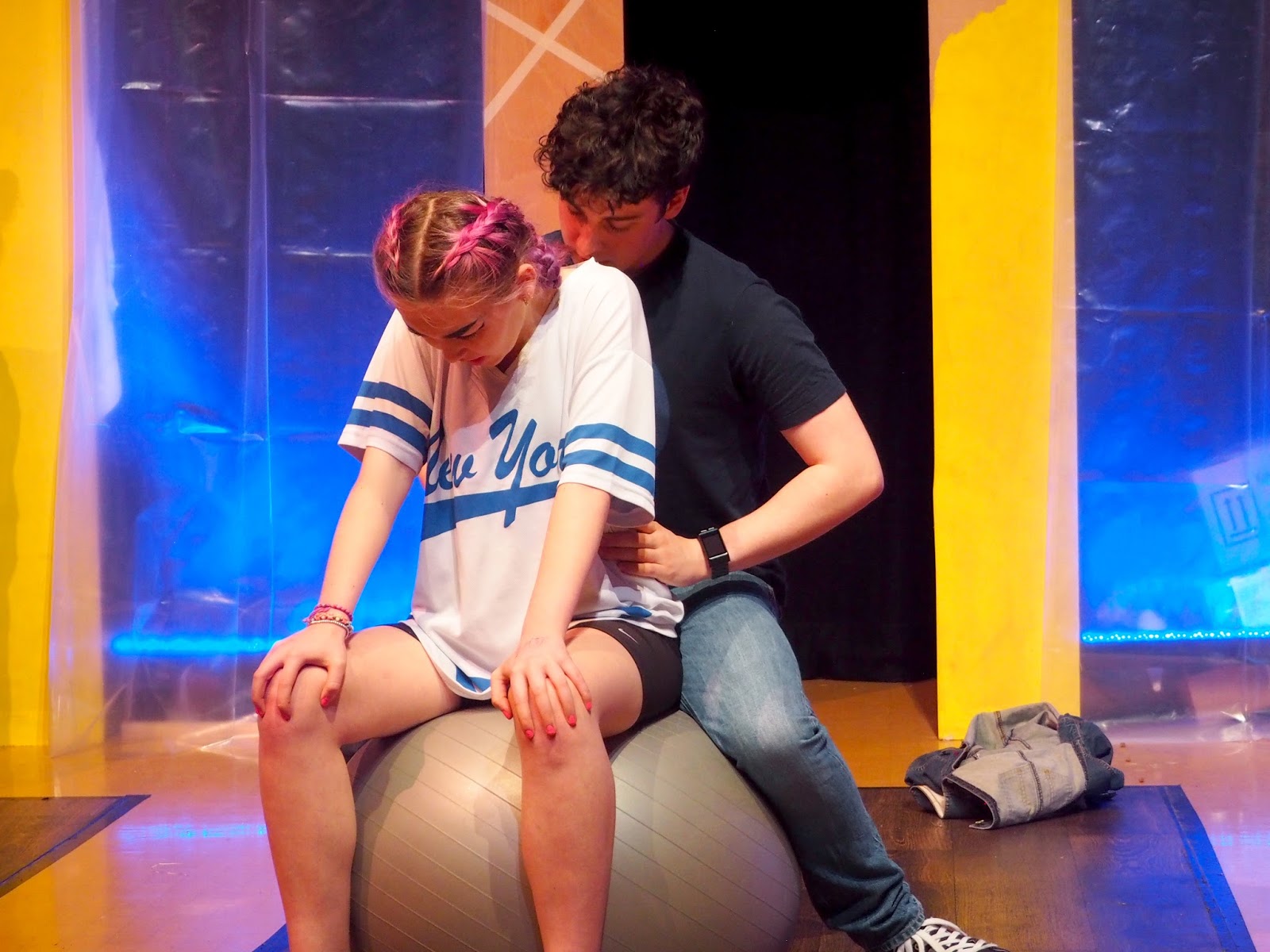
The clothing choices in this scene are the base layer and the New York tee pictured. I chose this tee for this scene because it is quite loose and allows for greater movement in the scene - also when people are giving birth they tend to wear loose clothing so that they can actually get the baby out. I also thought that this tee could have 'belonged' to Jamie and that Anna has 'stolen' the shirt from him showing how close they are in their relationship.

Scene 11


This tee is kept on. This is because Anna remains gave birth in her house so it would be assumed that she would wear the same shirt, possibly in order to feel closer to Jamie and to Bonnie.

Scene 12


Anna wears blue scrubs in this scene to show that she is in hospital. This would suggest to the audience that Anna is not coping after having Bonnie so has had to have special treatment - the ECT as shown in the following scene.

Scene 13 


Again, Anna is wearing hospital scrubs. This is needed because Anna has ECT in this scene.

Scene 14


Scene 15


Despite what is shown in these images, in the final performances we did not use this tee in this scene. in the dress rehearsal, we attempted to use this tee but it made the transition far too long. Instead, we used the same hospital scrubs from the previous scene. I think that we should have changed into this scene because Anna is home at this point and is desperately trying to find a connection with Bonnie and potentially with Jamie again which is why she'd wear this tee. Moreover, hospital scrubs would suggest she is in the hospital which she isn't and may have confused the audience as to her whereabouts.

Hair

In the play, I only varied my hairstyles twice. From Scene 2 to Scene 9 I had the following hairstyle (as seen from the back):


This allowed for none of my facial expressions to be blocked from view by my hair. 

The following hairstyle is what I chose for Scene 10 to Scene 15 (as shown from behind): 


This shows a marked decline in Anna's personal appearance. Moreover, it is practical for Scene 10 as people usually have their hair up when giving birth and also allowed Bruce's face to be at my neck without my hair getting in the way. 

Changes to Set 

There have been some small changes to the set since my previous blog about the set. Polythene has been put up between each doorway allowing for a better backstage area to store props. Moreover, the yellow paint that was applied to Anna's doorway has been rubbed away slightly to show that the paint has been there for a long time so Anna is changing it. the most marked change has been the timelines put above each doorway allowing the audience to understand when each story takes place. As shown in the image below, Carol's timeline begins in 1972, Anna's in 1995, and Bonnie's in 2024. 


TIE - Part 19

This Thursday we had our second performance of the TIE piece. Overall, this performance went better than the previous performance - I think ...