- The thoughts section received fewer laughs on my part, however, it was still effective.
- The translation of Act 1, Scene 2 was accurate as it was last week.
- I made sure that my speech was much clearer and much more pronounced during the reading of quotes from Act 3, Scene 4.
- My discussion with the TA part of the way through Act 1, Scene 7 was much better than it was last week. This was because I stuck to the structure that I had established in my previous blogs which allowed for better conversation and a better understanding of ideas. The girls who I was talking to easily grasped the concept of the sliders and were able to find quotes from this scene and later on in the play to solidify their ideas.
- My facilitation after Act 1, Scene 7 I think was much better than last week. This is because we had organised a way to get students' opinions on the matter. Moreover, I repeated what the students were saying and related back to what they were saying later in my facilitation when speaking to Bella after the facilitation. This repetition also made me listen more to what the students were saying which aided me in my facilitation.
- My discussion with the TA after Act 2, Scene 2 was much better because the students had to look for all the quotes. This meant that they were more engaged. Moreover, the girls who I was talking to were able to answer my question about other quotes that could be related to the quotes we had on the board.
- My facilitation of the hamartia section wasn't as good as my other sections of facilitation. This was because I fumbled on which slider I was talking about, however, I did recover from this.
Thursday, 9 May 2019
TIE - Part 19
This Thursday we had our second performance of the TIE piece. Overall, this performance went better than the previous performance - I think this was because I had a clear structure on how to talk to the TA when directly facilitating and talking to them. This performance we had a lower ability group, however, I think they had the same excellent grasp on Macbeth that the higher ability group did and were able to engage in the piece with ease - I think this was because we catered to their ability rather than the higher ability. Moreover, I felt that I pronounced words better than I had done in the previous performance. I will evaluate my performance below:

TIE - Part 18
After the performance last Thursday, we made some slight adjustments in order to amend mistakes made and to further enhance our facilitation. The amendments we made on Thursday after the performance and on Wednesday at N2C were mainly how to facilitate and the ending of the piece.
For the facilitation on Thursday's performance, we found that we didn't know how to ask appropriate questions to allow our TA to develop their understanding as our client wanted. Moreover, we found that in some aspects the facilitation was too complex in that we weren't explaining it appropriately or it was too simple for the higher ability students. The complicated section was during the character mixing desk where Leah spoke rather fast and thus the meaning was lost; the speed of talking and clarity of voice was something that we needed to improve on as a group. We were reminded that not all of our TA can differentiate between the characters and thus we needed to pronounce our words appropriately. Moreover, a good proportion of our TA have English as their second language so may not understand the character's names or what we're trying to get them to do. Thus, Leah has been told to slow down her words and have more enthusiasm and variation in her tone. The 'easy' section is our modern version of Act 2, Scene 2 - we felt that especially for higher level students that this was too easy and this could be similar to lower level students. Thus we asked them to find all quotes including the bonus quote and then afterwards we can single out the quote that we had before. This allows our TA to stay engaged in the piece. Additionally, Chipp has suggested that during the feeding back portion of the facilitation - that Leah, myself, and Maya engage in - we repeat and clarify what our TA mean in order to further their understanding. This allows the whole of our TA to hear what has been said and have the interpretation stick in their head.
At the ending of the piece on Thursday, three people spoke at the same time which our TA became confused at because they didn't know who to listen to. We decided to change it in order to allow our TA to know who to listen to and allows the things we're saying to be clarified.
Throughout the piece, we've made subtle adjustments in order to clarify our speech for the reasons suggested earlier in the blog.
For the facilitation on Thursday's performance, we found that we didn't know how to ask appropriate questions to allow our TA to develop their understanding as our client wanted. Moreover, we found that in some aspects the facilitation was too complex in that we weren't explaining it appropriately or it was too simple for the higher ability students. The complicated section was during the character mixing desk where Leah spoke rather fast and thus the meaning was lost; the speed of talking and clarity of voice was something that we needed to improve on as a group. We were reminded that not all of our TA can differentiate between the characters and thus we needed to pronounce our words appropriately. Moreover, a good proportion of our TA have English as their second language so may not understand the character's names or what we're trying to get them to do. Thus, Leah has been told to slow down her words and have more enthusiasm and variation in her tone. The 'easy' section is our modern version of Act 2, Scene 2 - we felt that especially for higher level students that this was too easy and this could be similar to lower level students. Thus we asked them to find all quotes including the bonus quote and then afterwards we can single out the quote that we had before. This allows our TA to stay engaged in the piece. Additionally, Chipp has suggested that during the feeding back portion of the facilitation - that Leah, myself, and Maya engage in - we repeat and clarify what our TA mean in order to further their understanding. This allows the whole of our TA to hear what has been said and have the interpretation stick in their head.
At the ending of the piece on Thursday, three people spoke at the same time which our TA became confused at because they didn't know who to listen to. We decided to change it in order to allow our TA to know who to listen to and allows the things we're saying to be clarified.
Throughout the piece, we've made subtle adjustments in order to clarify our speech for the reasons suggested earlier in the blog.
Saturday, 4 May 2019
TIE - Part 17
On Thursday we had our first performance of the TIE piece. There were certainly moments that worked well however, in some aspects there were limitations. I'm going to evaluate my own performance in relation to this:
Positives
Positives
- My role as one of the thoughts achieved laughs thus catering to the humorous element; this section clearly related to much of our TA and can be regarded as a success.
- During the general facilitation at the start of the piece, I focused on the person who was talking.
- My translation of Act 1, Scene 2 was clear.
- My reading of specific lines from Act 4, Scene 3 were emphasised correctly; moreover, I remembered them accurately.
- To some extent the 1st facilitation went well as I talked to a Y11 named 'John' who responded to my questions well enough.
- My explanation of what to do in the post 1,7 facilitation was clear.
- I covered for Leah in the Witches section effectively.
- The TA reacted exactly as we thought they would when confronted with the hamartia quote/physical representation which helped in the lack of enthusiasm when we said 'quote to prove it'.
- I remembered my quote during the argument - I am oft prone to forgetting it in rehearsal. (They have tied me to a stake I cannot fly but bear-like I must fight the course.)
Negatives
- My facilitation of Act 1, Scene 7 could have been much improved; I didn't stick to the structure set out in my previous blog and thus the conversation wasn't as good as I was expecting to have and thus was a little awkward.
- During the post 1,7 facilitation, I talked to a group of girls; the questions and explanations I offered weren't as clear as I would've wanted them to be and thus it felt awkward. Moreover, I feel like I impacted negatively on their understanding.
- There were no laughs when I was killed by Lauren as Duncan.
- My 2,2 facilitation was poor. 'John' immediately got the right answer and I forgot to ask my follow up questions and so I was stood in silence for most of the facilitation part. In the next performance I must stick to the structure I set out in my previous blog.
- I felt my facilitation post-hamartia could have been better and a lot clearer.
- I don't like the physical representation of the quote that Bruce gives - I think we should all just clear off the stage allowing more emphasis to be put on the quote.
- The part at the end where we all give advice was too complicated as there were 3 different people speaking at once and our TA didn't know who to look at.
Overall, I believe this was an effective first performance. I do think that my facilitation methods could be improved upon however, in general, the TA understood where I was coming from and knew the answers immediately. It's the follow up questions that I appear to have an issue with to extend their learning. Most of the things that need to be improved are a group thing or don't involve myself that much. Thus I believe the performance was somewhat effective.
TIE - Part 16
A major aspect to our TIE Macbeth piece is the use of facilitation. During the rehearsal period, when we've reached the point of facilitation (i.e. actually talking to our TA) we haven't been really discussing what we want our TA to be led to or how we're going to do this. The facilitation is potentially the most important part of the piece because it allows our TA to think for themselves and solidify the knowledge that they already have.
Before our first performance on Thursday, we discussed the importance of facilitation and how it should factor into the piece. The points of direct facilitation/contact occur at:
In class, we went through the above points of facilitation and predicted the answers that we may get from our TA and found ways to which we could deepen their understanding with secondary questions to make them think better. It's good to structure questions so that when getting feedback we get good responses.
At the moment, I do feel that we are massively up against time. As Director's Challenge ran on for a little longer than expected and with focus on the Y12 BTECs' performance of The Pillowman it has been hard to merely focus on TIE. Moreover, I do feel that we discussed for too long on certain aspects and didn't discuss enough on others. For example, we had massive debates on whether we needed 1,7 and 2,2 because of the similarities between the scenes but we didn't discuss much about the impact of Banquo nor the impact of the Witches and as a result these latter sections have been more rushed in the devising process and don't have the same level of thought behind them. Additionally, as this moment in time I don't believe we're fully prepared for the facilitation and discussion with our TA aspects of the piece because, as I mentioned earlier, we've been skipping over these bits in rehearsal - arguably, these are the most important parts of the piece. Nevertheless, with our first performance on Thursday it is important that our facilitation is to the best of our ability, although I do not know how I'll react when confronted with a room of Y11s!
Facilitation 1 - Correction of Joel's sliders
This is the first point of communication with the TA as a whole and as a result it needs to be quite strong in what we say and the questions that we ask. It must be noted that we are not trying to be teachers and as such should approach the TA as a friend - in some aspects this will be simple because we are of similar age to our TA (2 years difference) - but we still must appear knowledgeable in the subject. I think this may be a bit of an issue because I do think that a good majority of our class haven't done appropriate research into the topic and as such have limited knowledge - it could transpire that our TA know more about the subject than us however, on the other hand, this may be expected because they have been studying Macbeth for 2 years whereas our class have had about 3 months. Nevertheless, we must appear knowledgeable and this will assert our status for the rest of the piece.
Initial questions that we could ask are:
Before our first performance on Thursday, we discussed the importance of facilitation and how it should factor into the piece. The points of direct facilitation/contact occur at:
- The Character Mixing Desk for Act 1, Scene 7; occurs part of the way through the scene (whether the TA believe Joel has put the sliders in the correct place) and also at the end of the scene (whether the sliders stay the same throughout the scene or if they change).
- After Act 2, Scene 2 where we discuss where the modern day English quotes match up to the Shakespearean version.
- After hamartia, where we ask our TA what they believe Macbeth's fatal flaw is.
In class, we went through the above points of facilitation and predicted the answers that we may get from our TA and found ways to which we could deepen their understanding with secondary questions to make them think better. It's good to structure questions so that when getting feedback we get good responses.
At the moment, I do feel that we are massively up against time. As Director's Challenge ran on for a little longer than expected and with focus on the Y12 BTECs' performance of The Pillowman it has been hard to merely focus on TIE. Moreover, I do feel that we discussed for too long on certain aspects and didn't discuss enough on others. For example, we had massive debates on whether we needed 1,7 and 2,2 because of the similarities between the scenes but we didn't discuss much about the impact of Banquo nor the impact of the Witches and as a result these latter sections have been more rushed in the devising process and don't have the same level of thought behind them. Additionally, as this moment in time I don't believe we're fully prepared for the facilitation and discussion with our TA aspects of the piece because, as I mentioned earlier, we've been skipping over these bits in rehearsal - arguably, these are the most important parts of the piece. Nevertheless, with our first performance on Thursday it is important that our facilitation is to the best of our ability, although I do not know how I'll react when confronted with a room of Y11s!
Facilitation 1 - Correction of Joel's sliders
This is the first point of communication with the TA as a whole and as a result it needs to be quite strong in what we say and the questions that we ask. It must be noted that we are not trying to be teachers and as such should approach the TA as a friend - in some aspects this will be simple because we are of similar age to our TA (2 years difference) - but we still must appear knowledgeable in the subject. I think this may be a bit of an issue because I do think that a good majority of our class haven't done appropriate research into the topic and as such have limited knowledge - it could transpire that our TA know more about the subject than us however, on the other hand, this may be expected because they have been studying Macbeth for 2 years whereas our class have had about 3 months. Nevertheless, we must appear knowledgeable and this will assert our status for the rest of the piece.
Initial questions that we could ask are:
- Do you understand what we're doing? (In order to reinforce the task; if they don't understand it, we should explain further and relate it to our slider.)
- Where do you think the slider should go in the extract that we've just watched? (Allows them to not make single word answers although this is a closed ended question.)
- Can you pick out a moment in the scene we've just watched that shows this? (Directs the students to a specific point - asking a why do you think that question would only make them say 'I don't know' and this would be bad in aiding their understanding.)
- Are there any key quotes from this section or in the whole play that support this? (Makes them think a little more - relating to the whole play is something that they will have to do in their exam thus reinforcing their learning.)
- Do you think your slider is impacted on by the other sliders? (Allows for relation to different themes and may help them pick out what the overarching character trait of Macbeth is.)
- Other questions can be asked dependent on what the students say but this structure to questioning may be good.
Facilitation 2 - Whether Macbeth's sliders change in the scene?
Although I am not completely active in this facilitation because I am the main facilitator and so remain on stage, it is important to ponder what questions I could ask our TA if I see someone who's sat doing nothing. The questions for myself to begin with should be whether the sliders do change - the fact that we're asking the question does mean that we expect our TA to say that they do change. Indeed, I believe that all the sliders fluctuate but the main interpretation that we want to achieve is that ambition increases, guilt decreases and morality jumps around - this will be aided if we ask about the impact of Lady Macbeth.
Initial questions that we could ask are:
- Do you understand what we're doing? (Explanation for this as before.)
- From watching the 1,7 how do you think the sliders changed?
- Was there anything in particular in the scene that made you think this? Any quotes from this scene or actions?
- Are there any quotes that you can link this to from the rest of the play?
- Can you link the change to other sliders? Does one slider changing affecting yours or does your slider affect another slider?
Facilitation 3 - Modern to Shakespearean English
This facilitation has been done to enable our TA to better understand the quotes and so that they can be used in the exam with their proper meaning - allows our TA to not be confused. Moreover, this section allows our TA to stay engaged in the scene as they're looking for a specific translated quote.
Initial questions that we could ask are:
- Have you found the quote? Where about is it in the piece? (If they've not found it, I could ask them to translate the quote and then ask them where they think they heard something along those lines.)
- What do you think Shakespeare was trying to imply/suggest through this? Do you think you could relate this to the sliders from earlier?
- Have you found the bonus quote? What do you think Shakespeare was trying to suggest through this?
- Are there any other quotes or moments in the play that can relate to this quote?
The ability to explain what a quote means allows our TA to write better in their exam.
Facilitation 4 - Hamartia
I don't engage in this facilitation because I remain on stage.
Thursday, 25 April 2019
TIE - Part 15
The script below is what we have written/devised thus far - I would like to take credit for writing and recording lines to put int the script as it was quite stressful. The comments like this are my opinions on certain parts of the script:
(General welcomings in. Everything hopefully settles down
and then – our fake students enter. They sit down at their exam chairs. The
thoughts pop up from behind them and begin massaging shoulders, calming them
down etc.)
BRUCE: You have 2 hours in which to complete the extracts in
front of you. Your time begins now!
MARLON: Okay okay etc
PETER: Breathe in. And out. Okay.
HANNAH2: Okay, okay. That’s a really good letter A and its
sunny outside. Ohmygod. Nope! We need to focus on Macbeth.
MARLON: Right. Okay. There’s nothing. Let’s just have a look
round – ohmygod she’s wrote loads!
PETER: Blah blah blah waffle waffle waffle. Lady Macbeth and
power. Done. What does that even mean?!
HANNAH2: Art thou a man? Nope, cross it out.
PETER: Oh god the examiners here, don’t look, okay we’re
looking.
(Fart joke)
BRUCE: You have five minutes remaining.
(Various states of panic. And then. Calm)
PETER: There’s a question two!
The humorous element here allows for us to engage with our TA on the same frontier - we are on the same side and thus will get the important information across much easier as our TA won't be fighting us. On the other hand, this could result in our TA feeling a bit awkward as the scene may not be as funny as we're making it out to be.
(Panic. The thoughts freeze. Chatting with TA along lines of
look how stressed they are you don’t ant to be like that.)
KATHRYN: Hi guys! We’re N2C. We’re here today to help you
with your exam so that you don’t end up like our fake students here.
HANNAH1: This is an interactive performance so we want you
guys to get involved.
IZZY: So, let’s take you out of the exam hall so we can talk
to you about Macbeth properly.
JOEL: I don’t get it. He’s supposed to be the hero but ends
up being the bad guy?
H2: Yeah, but he starts
as the hero, you remember that?
ALEX: Oh yeah, he was in a war right?
BELLA: He got called ‘Valour’s Minion’ didn’t he?
LAUREN: That’s right. Let’s take a look at Act 1, Scene 2.
So, before we start we’ve got translated quotes on the board here. Let’s go
We've fully sorted this small section out - by writing it down and having a concrete way of how lines fall enabled us to get through the scene faster.
(Battle. Shouting and the like. Translations of the lines –
Kathryn, Izzy, and Hannah2. And then - )
JOEL: So the brandished steel that smoked with bloody
execution, that’s his sword right?
ALEX: Okay, but I still don’t get how he turns into the
villain if he was so good to begin with.
IZZY: Well, he kills Duncan, Banquo – although Fleance
escapes.
BELLA: Everybody was killing everybody back then though so
why does that make him a villain?
KATHRYN: He kills the king and that’s regicide. Don’t you
remember the Divine Right of Kings?
(Non-committal mutterings)
PETER: And he killed children!
BELLA: When?
PETER: After he finds out Macduff is a threat to him, Macbeth
kills his family.
JOEL: Oh yeah! And all his chickens!
ALEX: They are the kids you idiot.
We're hoping that the fake students have the same questions our TA have and may be too frightened to ask. Thus by having Joel acting like an utter fool it may make them feel better about themselves.
(Act 4, Scene 3 – murder of the children and stuff with
translations – Bruce and Hannah2)
ALEX: Wow, look at all the chickens.
JOEL: That’s not funny, this is terrible. Macduff thought
they were safe when he left them.
BELLA: And they should have been.
JOEL: He must have been devastated.
BRUCE: He was devastated.
Let’s take a look at Macduff’s reaction in Act 4, Scene 3. Peter you can be
Macduff and I’ll be Malcolm.
(Small scene)
MARLON: So, here we see Macbeth abusing his power as king to
assert dominance and engage in the slaughter of innocents thus leading to his
downfall.
I like the above line because this is how I would write in an exam. By including this, it allows our TA to see how they should be writing - we may need to make this little aim a bit clearer. But its fine for now if we don't explicitly want to make that point - I just like fancy language!
JOEL: I don’t get it.
MARLON: This is Macbeth. Macbeth indirectly murders
Macduff’s family. Macduff wants revenge so kills Macbeth. Do you get it now?
BELLA: Yeah. Okay so, I get he was a hero that became a
villain. Why did he turn evil? I don’t get it. What made him that way?
BRUCE: Shall we look at the relationship between Macbeth and
Lady Macbeth in order to understand how Macbeth became a tragic hero?
ALEX: Why are they standing behind those chairs?
LEAH: This is our Character Mixing Desk! It shows the
different emotions that a character may feel throughout a scene which in turn
gives different interpretations. On our first slider we have:
H1: Ambition. This is the thirst for power.
LEAH: On our second slider we have –
MARLON: Guilt. The feeling you get after doing something
wrong.
LEAH: And our third and final slider –
LAUREN: Morality. The inner feeling of right or wrong.
LEAH: So, let’s set the sliders where we think Macbeth is
throughout the scene. Joel, would you like to give it a go?
(Joel sets them wrong because his character is a fool)
LEAH: Joel, have you actually read Macbeth?
JOEL: Yeah. I read the SparkNotes!
LEAH: Right. Let’s see if you think Joel is right by
watching Act 1, Scene 7.
By Joel setting the sliders wrong it allows our TA to pick up on the mistake and stay engaged within the piece. Moreover, many students may have just 'read the SparkNotes' and thus may be in a similar position to Joel - this will hopefully get our TA on side.
(1,7 – Bruce acts it guilty and nervously. Pauses at – I
dare do all that may become a man, who dares do more is none)
LEAH: Let’s pause it there and take a look at those sliders
again. Do you think Joel set them right? No, Joel did it wrong! I’m gonna split
you into 3 groups. Alex, Bella, Joel’s team take (slider) and talk to the people
around you about how we could change the sliders.
(Interacting with audience for 60 secs. Quotes from the
scene are on our powerpoint – reference these in the discussion.)
LEAH: Alright, so that was some great discussion. Shall we
set the sliders to where they should be?
(Each section is responsible for each slider – Alex =
ambition; Bella = guilt; Joel = morality. We ask our TA for where the sliders
should be.)
LEAH: Okay, shall we continue the scene.
(The scene continues, Bruce seems a lil angrier?)
HANNAH2: That was brilliant guys. But, do you think the
Macbeth sliders stay the same throughout the scene or do they change? Have a
quick chat with the people sitting around you. We’ll be over to help.
(Feedback. Setting the sliders??)
HANNAH2: What was everyone’s opinion? Alex/Bella/Joel input.
The many different parts of discussion engage our TA. The use of facilitation by asking open-ended questions allows our TA to think for themselves and not get bored - they can apply their knowledge to the piece they are seeing and thus can feel like they're getting somewhere.
BELLA: I get that but I feel like Lady Macbeth drives him to
be like this.
H2: You’re right. And a good scene that shows this is Act 2,
Scene 2.
BELLA: Which scene is that?
JOEL: Macbeth just killed Duncan.
LAUREN: What is this dagger which I see before me?
(Proceeds to stab Hannah2. Only the students react –
facilitators stay deadpan)
We made another small sequence here where we actually saw Macbeth killed Duncan. We scrapped this for two reasons: 1) Act 2, Scene 2 already shows this with our translation into modern English as described below. 2) We felt like a quick, snappy transition was needed.
BELLA: Can we do it in English this time?
KATH: Shakespeare is English.
ALEX: Proper modern day English
MARLON: Yeah, that’s a good idea. So for this we’re gonna
put you in teams and have you closely look at the scene using the quotes that
are on the board behind us.
??: This is Joel’s team.
(Joel’s quote)
??: This is Bella’s team.
(Bella’s quote)
LAUREN: And this is Alex’s team.
(Alex’s quote)
MARLON: So, what we want you to do is find the modern day
English version of the Shakespearean quote to win some points for your team. We
good? Let’s go!
JOEL: Wait! What’s that quote in red?
KATHRYN: I’m glad you reminded me. That bad boy is your
bonus quote. If you find this quote you get some extra points for your team.
JOEL: What do we get if we win?
HANNAH2: A GCSE in English.
Humour allows for engagement.
(Modern version of 2,2 – Izzy and Peter)
FACILITATION
We haven't scripted the facilitation of this scene yet because Maya wasn't in class and she knows the right lines to say. There may need to be a contingency plan put in place here.
ALEX: Alright so he’s a decent person who gets pushed by his
wife. But he’s a hero so how did he
get like this?
LAUREN: That is the influence of the supernatural – the witches.
JOEL: Dem witches be crazy!
BELLA: I get that the witches say that stuff but I’m confused.
LEAH: The prophecy works like this.
MARLON: Macbeth without witches.
PETER: I’m Banquo.
IZZY: I’m Macbeth.
KATHRYN: I’m MacDonald and I’m gonna stab you.
(Stab – kath dies)
H1/LAUREN: Oh no
H2: I am King Duncan. Welcome Macbeth. You can be Thane of
Cawdor.
IZZY: Thank you.
LEAH: I’m Lady Macbeth
IZZY: I’m Thane of Cawdor.
LEAH: That makes me hot.
MARLON: And they all lives happily ever after.
BELLA: That’s not very tragic!
MACBETH: Exactly. Macbeth with witches.
PETER: I’m Banquo.
IZZY: I’m Macbeth.
H1/L/K: We’re the witches
KATH: You’re gonna be thane of Cawdor and king
IZZY: That’s cool
H1/L: Your kids are gonna be king when Macbeth dies.
PETER: Nice.
IZZY: Hey.
LEAH: Hi
IZZY: I’m Thane of Cawdor and I’m gonna be king.
LEAH: That makes me super hot.
H2: I’m Duncan.
IZZY: I quite like him.
LEAH: Do it.
(STAB)
IZZY: what’s the point in being king if my son’s aren’t
gonna be king? Assassins!
(Peter dies. Bruce runs away)
IZZY: Everything’s gonna be okay?
K/L/H1: You’ll be okay until Birnam Wood comes to Dunsinane
Hill
IZZY: Trees can’t move
K/L/H1: No man of woman born can harm you
IZZY: Everyone’s been born!
KK/L/H1: Be careful of Macduff.
MARLON: I’m Macduff. And my family is over there.
IZZY: Assassins.
(Leah and Bruce die)
MARLON: I’m gonna get revenge. Let’s get camouflaged. Cut
down those trees.
IZZY: The trees are moving.
MARLON: I’m Macduff.
IZZY: you can’t kill me because you were born!
MARLON: Fun fact: I was born by c-section.
IZZY: Oh.
MARLON: Stab
(Izzy dies)
BELLA: That was pretty tragic.
The comparison of the play with and without witches is something that my group worked on a couple of months ago in preparation for the piece. It allows our TA to see the major impact the witches have on the piece.
ALEX: Yeah but Banquo got a prophecy too but he didn’t turn
evil.
MARLON: Banquo is a good person. He thought that fate was
best left alone. We’ll show you.
LEAH: Example number one: The witches.
MARLON: Macbeth’s view.
IZZY: Wow, witches are telling me I’m gonna be king. That’s
awesome.
LEAH: Banquo’s view.
PETER: I don’t care either way – whatever happens will
happen.
EVERYONE: Quote to prove it.
LEAH: Example number two: After Duncan’s death.
MARLON: Macbeth’s view.
IZZY: I’m king. Wow.
LEAH: Banquo’s view.
PETER: I’m suspicious. I fear he’s done a terrible thing.
EVERYONE: Quote to prove it.
LEAH: Example number three: Why Macbeth kills Banquo.
IZZY: I’m afraid he might know I killed Duncan. He’s so
honest and good.
MARLON: He even sacrfices himself for his son.
PETER: No.
EVERYONE: Quote to prove it.
LEAH: Example number four.
EVERYONE: We don’t have one.
Our client suggested that we include the comparison of Banquo and Macbeth as seen above and below this comment. Our client wanted us to focus on the hamartia (fatal flaw) - this is something I reference in the opening sequence - because this is a key English term that our TA have been encouraged to use in their exam.
JOEL: So what is it about Macbeth that makes him take this
so seriously? What makes him go bad?
H2: Hamartia
JOEL: I don’t really like sushi.
KATH: No, no. Hamartia.
JOEL: A martian. That’s such a good film.
ALEX: It was good wasn’t it.
JOEL: I didn’t think it would maintain my interest.
BRUCE: No, you’re going off topic.
EVERYONE: Hamartia.
JOEL: Hermione. Isn’t she that clever one from Harry Potter.
Have you seen her lately, she’s proper fit!
ALEX: She’s like eleven.
JOEL: No, I’ll show you a picture.
ALEX: Oh she is fit isn’t she.
EVERYONE: No! Hamartia.
JOEL: Oh. What’s that mean?
KATH: Hamartia is the fatal flaw. The thing that is broken
in Macbeth but could also be a good thing if used correctly.
H2: Do you remember the sliders?
JOEL: I was quite good at those.
H2: Which one of these represents Macbeth’s fatal flaw? Have
a quick discussion and we’ll be around to help you.
(Discussion)
H2: This is morality.
LAUREN: I know that I’m doing something wrong. I know I
shouldn’t kill the king. It’s bad and a last resort.
H2: Do we really think Macbeth is the fatal flaw? Or is it
overshadowed by something else like guilt?
MARLON: At the beginning I felt terrible about killing Duncan,
I couldn’t even look at his body but slowly I felt that things became less bad.
H2: So, maybe not guilt then. Something must be overpowering
that. Ambition?
H1: I started when the witches told me I wasn’t going to be
king and when I wasn’t made Prince of Cumberland as that was the only legal way
I could be king. It spiralled from there.
H2: And that’s why we think Ambition is Macbeth’s fatal
flaw. So, we’re going to show a physical representation of a key quote that we
think shows this? You ready?
MARLON: On your marks, get set, go!
H2: I need to go faster, so I’m using the spurs on my horse!
Oh a jump, we need to go faster! Ohhhhhhhhh Noooooooooooooo.
EVERYONE: Do you get it etc.
EVERYONE: Quote to prove it.
JOEL: Okay, so what would be a good quote to show Macbeth’s
change?
(Argument!)
BRUCE: I’ve got one:
I have supp’d full with horrors, direness familiar to my slaughterous
thoughts cannot start me.
EVERYONE: That’s pretty good! What does it mean?
BRUCE: It’s like he’s so full of the evil things that he’s
done that he can’t stop thinking about them and everything bad that happens is
not as bad as the things going on in his head.
(Image)
H1: Are you ready to retake the exam?
The use of quotes throughout allows our TA to take these quotes and use them in the exam if they feel like they haven't done much revision.
The performance dates that we have been given are Thursday 2nd and 9th of May. We still have quite a bit to do in order to reach the time set and to make the piece very slick. It may be worth checking our original client notes to see what else we could do.
Monday, 1 April 2019
TIE - Part 14
In order for us to remember what we have done, I wrote a play script which has most if not all the lines said by various people. These are subject to change as will be seen later in the blog, however, as people keep changing what they say each time they say it, there was confusion as to who says what as will be shown by the script:
(General welcomings in. Everything hopefully settles down and then – our fake students enter. They sit down at their exam chairs – and desks? The thoughts pop up from behind them and begin massaging shoulders, calming them down etc.)
BRUCE: You have 2 hours in which to complete the extracts in front of you. Your time begins now!
MARLON: Okay okay etc
PETER: Breathe in. And out. Okay.
HANNAH2: Okay, okay. That’s a really good letter A and its sunny outside. Ohmygod. Nope! We
need to focus on Macbeth.
MARLON: Right. Okay. There’s nothing. Let’s just have a look round – ohmygod she’s wrote loads!
PETER: Blah blah blah waffle waffle waffle. Lady Macbeth and power. Done. What does that even mean?!
HANNAH2: Art thou a man? Nope, cross it out.
PETER: Oh god the examiners here, don’t look, okay we’re looking.
(Fart joke)
BRUCE: You have five minutes remaining.
(Various states of panic. And then. Calm)
PETER: There’s a question two!
(Panic. The thoughts freeze. Chatting with TA along lines of look how stressed they are you don’t ant to be like that.)
KATHRYN: Hi guys! We’re N2C and we’re here today to help you in your exams in July so hopefully you don’t end up like our fake students here.
(Does someone else say something here? Maya?)
HANNAH1: This is an interactive performance so we want you guys to get involved.
IZZY: So, let’s take you out of the exam hall so we can talk to you about Macbeth properly.
(We do as is said)
HANNAH2: What can you remember about the play? Remember, Macbeth starts off as the hero?
JOEL: Yeah he does but he’s not even in the beginning, I don’t get it.
HANNAH2: Right that’s because he’s described as the hero by the Captain in Act 1, Scene 2.
BELLA: Oh yeah. He got called “Valour’s minion” didn’t he?
LAUREN: That’s right. So, shall we take a look at that scene? The battle?
(Battle. Shouting and the like. Translations of the lines – Kathryn, Izzy, and Hannah2. And then - )
JOEL: So the brandished steel that smoked with bloody execution, that’s his sword right?
(Is there something here?)
ALEX: Okay, but I still don’t get how he turns into the villain if he was so good to begin with.
IZZY: Well, he kills Duncan, Banquo – although Fleance escapes – and Macduff’s entire family.
BELLA: Everybody was killing everybody back then though so why does that make him a villain?
KATHRYN: He kills the king and that’s regicide. Don’t you remember the Divine Right of Kings?
(Non-committal mutterings)
PETER: And he killed children!
BELLA: When?
PETER: After he finds out Macduff is a threat to him, Macbeth kills his family.
JOEL: Oh yeah! And all his chickens!
ALEX: They are the kids you idiot.
(PETER: Shall we have a look at how villainous Macbeth is portrayed? - ??)
(Act 4, Scene 3 – murder of the children and stuff with translations – Bruce and Hannah2)
ALEX: Wow, look at all the chickens.
JOEL: That’s not funny, this is terrible. Macduff thought they were safe when he left them.
BELLA: And they should have been.
JOEL: He must have been devastated.
BRUCE: He was devastated. Let’s take a look at Macduff’s reaction in Act 4, Scene 3. Peter you can be Macduff and I’ll be Malcolm.
(Small scene)
MARLON: Macbeth did this to show his ultimate power over Macduff but in doing so set himself up for tragedy as Macduff would only want revenge.
JOEL: I don’t get it.
MARLON: This is Macbeth. Macbeth indirectly murders Macduff’s family. Macduff wants revenge so kills Macbeth. Do you get it now?
BELLA: Yeah. Okay so, I get he was a hero that became a villain. Why did he turn evil? I don’t get it. What made him that way?
MARLON: There are lots of different ideas about why Macbeth turned evil. Let’s have a look at the Lady Macbeth interpretation in Act 1, Scene 7.
ALEX: Why are they standing behind those chairs?
LEAH: This is our Character Mixing Desk! It shows the different emotions that a character may feel throughout a scene which in turn gives different interpretations. On our first slider we have:
PETER: Ambition.
LEAH: On our second slider we have –
MARLON: Guilt.
LEAH: And our third and final slider –
LAUREN: Morality.
LEAH: So, let’s set the sliders where we think Macbeth is throughout the scene. Joel, would you like to give it a go?
(Joel sets them wrong because his character is a fool)
LEAH: Shall we have a look at Act 1, Scene 7 and see if you all agree with where Joel has put the sliders?
(1,7 – Bruce acts it guilty and nervously. Pauses at – I dare do all that may become a man, who dares do more is none)
LEAH: Let’s pause it there and take a look at those sliders again. So Joel was saying that Macbeth has high ambition, no guilt, and questionable morals. Does that seem right from watching the scene? With the people sat around you have a quick discussion about where you think the sliders should be. We’ll come around to help you.
(Interacting with audience for 60 secs. Quotes from the scene are on our powerpoint – reference these in the discussion.)
LEAH: Alright, so that was some great discussion. Shall we set the sliders to where they should be?
(Each section is responsible for each slider – Alex = ambition; Bella = guilt; Joel = morality. We ask our TA for where the sliders should be.)
LEAH: Okay, shall we continue the scene?
(The scene continues, Bruce seems a lil angrier?)
HANNAH2: That was brilliant guys. But, do you think the Macbeth sliders stay the same throughout the scene or do they change? Have a quick chat with the people sitting around you. We’ll be over to help.
(Feedback. Setting the sliders??)
HANNAH2: So, we’ve seen Macbeth’s character development throughout the scene, what about Lady Macbeth? It’s clear that from Macbeth’s changes that Lady Macbeth has a clear impact but her character on the sliders could be perceived as – having extremely high ambition, having really low
guilt and morality.
MAYA: But, does this change in Act 2, Scene 2. Let’s have a look at that scene.
BELLA: Which scene is that?
JOEL: Macbeth just killed Duncan.
LAUREN: What is this dagger which I see before me?
(Proceeds to stab Hannah2. Only the students react – facilitators stay deadpan)
ALEX: Can we do it in English this time?
??: Shakespeare is English.
BELLA: Proper modern day English
MARLON: Yeah, that’s a good idea. So for this we’re gonna put you in teams and have you closely look at the scene using the quotes that are on the board behind us.
??: This is Joel’s team.
(Joel’s quote)
??: This is Bella’s team.
(Bella’s quote)
LAUREN: And this is Alex’s team.
(Alex’s quote)
MAYA: So, what we want you to do is find the modern day English version of the Shakespearean quote to win some points for your team. We good? Let’s go!
JOEL: Wait! What’s that quote in red?
MAYA: I’m glad you reminded me. That bad boy is your bonus quote.
KATHRYN: (whatever the line is)
MAYA: If you find this quote you get some extra points for your team.
JOEL: What do we get if we win?
HANNAH2: A GCSE in English.
MAYA: Alright guys let’s go.
(Modern version of 2,2 – Izzy and Peter)
The major thing that has been changed since writing this script is the way that we have facilitated 1,7 and 2,2 as per our discussion concerning 2,2 as talked about in my previous TIE blog. The issue that I had was the way in which we introduced 1,7 - instead of saying how Lady Macbeth influences Macbeth before 1,7, Marlon simply introduces the sceen so we can see how Macbeth starts off in his character development. Leah, as the main facilitator in 1,7 has the sliders to introduce themselves and what they mean so that our TA can better understand where we are coming from. When I enter as the facilitator at the end of 1,7 I mention the quotes on the board from the beginning, middle and end of the scene and ask our TA how they think Macbeth's character has changed overall. It's after I've receieved feedback concerning this, that I talk about Lady Macbeth and then how she involved herself in Macbeth's character development which leads onto 2,2. This is a much better way of introducing our ideas in my opinion and this was the major change during the last few weeks.
TIE - Part 13
For the past couple of weeks, we've looked at Act 2, Scene 2 of Macbeth and how we can facilitate it. The overall consensus was that we use a modern day English version of the scene and translate said scene ourselves so that we have a better understanding of the scene ourselves in order to talk to our TA audience about it.
The modern-day English version runs thus:
LM: The wine that we have drunk has made them weak but me brave, I can do this, I'm ready. Nothing can stop me. (Gasp). Okay, it was just an owl. Macbeth is doing it, everything is ready. The doors are open. I've drugged them, they have no idea what's going on.
M: Who's there? Tell me!
LM: Oh my god, are they awake? If we get through this, if nobody sees him going in or out, we'll be okay. (Listening). I've put everything our there's no way he could have missed the daggers. I would've killed Duncan myself if he didn't look like my dad whilst sleeping.
(Enter M).
LM: Macbeth.
M: I've done it, didn't you hear?
LM: I heard an owl, nothing unusual. Didn't you just call out?
M: When?
LM: Just now.
M: Yes, when I came back.
LM: Yeah.
M: Shh. Who's sleeping next door to Duncan?
LM: Donalbain.
M: This is a sorry sight.
LM: Don't talk like that.
M: One laughed and one shouted murder. I heard them wake each other up but they said their prayers and then went back to sleep.
LM: There's two in the same room.
M: They shouted 'God bless' and 'Amen'. It was like they had seen the blood on my hands so I could not say Amen back.
LM: Stop overthinking.
M: Why couldn't I say amen? I needed to say it for God's forgiveness but I couldn't.
LM: We shouldn't think about it. It'll make us crazy.
M: I thought I heard someone say Macbeth murders sleep. Sleep that is healing and pure and soothing and necessary for life.
LM: What do you mean?
M: The voice shouted throughout the house, sleep no more. Thane of Glamis has murdered sleep, therefore, Cawdor cannot sleep. Macbeth cannot sleep.
LM: Who said that? Why are you thinking about it so much? Go and get some water and wash the blood from your hands. Why did you bring the dagger back? They must stay there. Go and take them back and cover the guards with his blood.
M: I'm not going back, I'm afraid of what I have done, I don't want to see his dead body again.
LM: You coward! Give me the daggers. The sleeping and the dead look the same but only children fear the dead. If he bleeds I'll smear the blood on the guards because they need to look like the murderers.
(LM exits).
M: Wait, can you hear knocking? Why does every noise scare me? I don't even recognise myself. Even holy water couldn't clean my hands, I'd just turn it red.
(Enter LM).
LM: My hands now have blood on them - stop being so pathetic. I can hear knocking at the south door. Let's go to bed and wash our hands. It's easy. You've lost your mind, stop daydreaming. Listen. More knocking. Put on your nightgown, let's act like it didn't happen in case someone comes to get us it looks like we've been asleep. Snap out of it.
M: I can't believe what I've done. I wish that knocking would wake Duncan, I would wake him if I could.
There was much discussion about how to facilitate the scene and it took on the form of a debate about how similar Act 1, Scene 7 and Act 2, Scene 2 were in terms of character development. The image below shows our different ideas about how we could facilitate this scene and indeed future scenes in the piece:
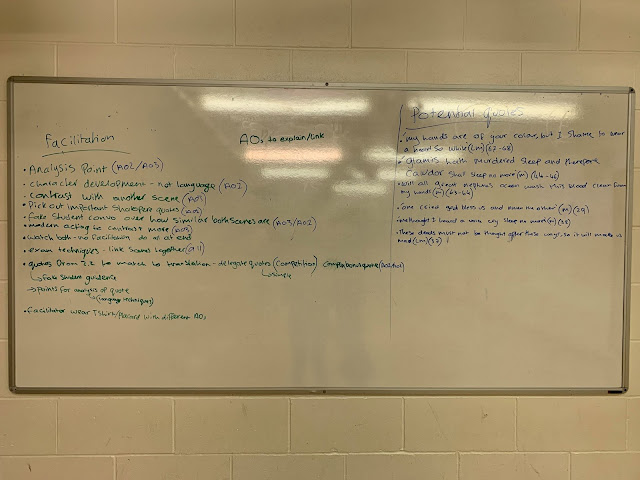
I led the debate on the similarities between 1,7 and 2,2. I suggested that maybe we shouldn't focus on these scenes because of the lack of character development which is what we were trying to achieve with the piece and how different elements caused Macbeth to turn from hero to villain. The lack of change was disturbing. The argument that Peter put forward was that this scene was to show the impact that Lady Macbeth had on Macbeth. I countered this by suggesting that this was precisely what we were doing in 1,7 so didn't see why there was a need to repeat the exercise in a new way. To be honest, I'm still quite confused. Nevertheless, it was decided that we would facilitate 1,7 to show Macbeth's character and 2,2 to show the impact Lady Macbeth would have on Macbeth.
The video below shows the facilitation that I took part in:
Mr Jones, an English teacher and thus part of our client base, joined us in the latter part of the lesson and watched the two facilitations on offer. The video below shows the discussion that we had with him. It confirmed that what we were doing was what our client would want from the piece:
The modern-day English version runs thus:
LM: The wine that we have drunk has made them weak but me brave, I can do this, I'm ready. Nothing can stop me. (Gasp). Okay, it was just an owl. Macbeth is doing it, everything is ready. The doors are open. I've drugged them, they have no idea what's going on.
M: Who's there? Tell me!
LM: Oh my god, are they awake? If we get through this, if nobody sees him going in or out, we'll be okay. (Listening). I've put everything our there's no way he could have missed the daggers. I would've killed Duncan myself if he didn't look like my dad whilst sleeping.
(Enter M).
LM: Macbeth.
M: I've done it, didn't you hear?
LM: I heard an owl, nothing unusual. Didn't you just call out?
M: When?
LM: Just now.
M: Yes, when I came back.
LM: Yeah.
M: Shh. Who's sleeping next door to Duncan?
LM: Donalbain.
M: This is a sorry sight.
LM: Don't talk like that.
M: One laughed and one shouted murder. I heard them wake each other up but they said their prayers and then went back to sleep.
LM: There's two in the same room.
M: They shouted 'God bless' and 'Amen'. It was like they had seen the blood on my hands so I could not say Amen back.
LM: Stop overthinking.
M: Why couldn't I say amen? I needed to say it for God's forgiveness but I couldn't.
LM: We shouldn't think about it. It'll make us crazy.
M: I thought I heard someone say Macbeth murders sleep. Sleep that is healing and pure and soothing and necessary for life.
LM: What do you mean?
M: The voice shouted throughout the house, sleep no more. Thane of Glamis has murdered sleep, therefore, Cawdor cannot sleep. Macbeth cannot sleep.
LM: Who said that? Why are you thinking about it so much? Go and get some water and wash the blood from your hands. Why did you bring the dagger back? They must stay there. Go and take them back and cover the guards with his blood.
M: I'm not going back, I'm afraid of what I have done, I don't want to see his dead body again.
LM: You coward! Give me the daggers. The sleeping and the dead look the same but only children fear the dead. If he bleeds I'll smear the blood on the guards because they need to look like the murderers.
(LM exits).
M: Wait, can you hear knocking? Why does every noise scare me? I don't even recognise myself. Even holy water couldn't clean my hands, I'd just turn it red.
(Enter LM).
LM: My hands now have blood on them - stop being so pathetic. I can hear knocking at the south door. Let's go to bed and wash our hands. It's easy. You've lost your mind, stop daydreaming. Listen. More knocking. Put on your nightgown, let's act like it didn't happen in case someone comes to get us it looks like we've been asleep. Snap out of it.
M: I can't believe what I've done. I wish that knocking would wake Duncan, I would wake him if I could.
There was much discussion about how to facilitate the scene and it took on the form of a debate about how similar Act 1, Scene 7 and Act 2, Scene 2 were in terms of character development. The image below shows our different ideas about how we could facilitate this scene and indeed future scenes in the piece:

I led the debate on the similarities between 1,7 and 2,2. I suggested that maybe we shouldn't focus on these scenes because of the lack of character development which is what we were trying to achieve with the piece and how different elements caused Macbeth to turn from hero to villain. The lack of change was disturbing. The argument that Peter put forward was that this scene was to show the impact that Lady Macbeth had on Macbeth. I countered this by suggesting that this was precisely what we were doing in 1,7 so didn't see why there was a need to repeat the exercise in a new way. To be honest, I'm still quite confused. Nevertheless, it was decided that we would facilitate 1,7 to show Macbeth's character and 2,2 to show the impact Lady Macbeth would have on Macbeth.
The video below shows the facilitation that I took part in:
The main idea that we were trying to get across was the use of Shakespearean quotes and what they mean in modern-day English. This would enable our TA to better understand the quotes we have chosen - the ones from the video are vital quotes from Act 2, Scene 2 which could be used in an essay on this subject - and will aid them in their exams. The idea of splitting our TA into teams allows for better cooperation and for them to stay involved in the piece rather than drift off elsewhere. The interactiveness and humour imbued into the scene means that our TA will want to stay involved and makes our job as facilitators much easier than before.
Mr Jones, an English teacher and thus part of our client base, joined us in the latter part of the lesson and watched the two facilitations on offer. The video below shows the discussion that we had with him. It confirmed that what we were doing was what our client would want from the piece:
Director's Challenge - Part 29 - Final Performance
On Monday and Tuesday after school, as specified in my previous blog, we did multiple line runs which enhanced the performance.
On Tuesday afternoon, the DNA directors prepped the set as seen in the image below:

The changes that we made from the original set design include:
The final costume can be seen below. Each of the cast members took into consideration the costume specified by us in messages sent as can be seen in previous blogs.
The video below shows the final performance on Tuesday 26th March 2019:
On Tuesday afternoon, the DNA directors prepped the set as seen in the image below:

The changes that we made from the original set design include:
- the removal of trees from around the risers, replacing them with twigs and leaves on the ground
- the removal of a campfire and log which would have just clogged the space up
- the swapping of crates for white blocks - the crates were dangerous to use; the blocks were created for another director's play and we thought they could be useful
In a professional performance, I would have wanted a tree or two for characters to climb or indeed a place high above the others for Leah and Phil to sit in a field.
The final costume can be seen below. Each of the cast members took into consideration the costume specified by us in messages sent as can be seen in previous blogs.
 |
| Cast from left to right - Back row: Evie (Leah), Grace (Rachel), Kate (Phil), Ollie (Mark), Tom (John-Tate); Front row: Megan (Jan), Hannah (Cathy/Director), Imogen (Director). |
The following bullet points is the analysis of the above video in order of the performance, split into relevant scenes:
Scene 1
- Having Leah and Phil on from the beginning was potentially a mistake - especially at the blackout. Instead, we should have had Jan and Mark walk offstage and have a snappy split-stage which I think is what we wanted from the beginning.
Scene 2
- The tub of ice cream was for a more pragmatic reason. Instead of having a cone, the tub provided an easy way to put it back in the bag after the scene had ended.
- Evie stays at the front of the stage for too long at the "Like I talk too much" section - there is a distinct lack of movement here. Perhaps this was due to nerves. Whilst looking back on the video, it may have made sense to use the white block on stage left.
- There was an issue with the lighting desk throughout this scene, hence the flickering lights which we didn't want in this scene.
- Evie had a great change in tone at the "You're not scared" section although there could have been better clarity in her sentences i.e. where one ended and the other began - this was a constant theme with Leah's monologues I found.
- As I've said previously to Evie the "I'm not ashamed!" line needed to be much stronger and more self-assured than what was being portrayed.
- Evie needed to wait for a little before saying "Oh shit" in order for it to seem more naturalistic. This was probably because we didn't practise this part as much as we did the other parts.
- The slow packing away of food done by Kate at the end of the scene was done for humorous effect - I stole this idea from Hannah Lovell from last year's Director's Challenge.
- The lighting desk light shouldn't have been turned off until the end of the scene.
Transition
- There was a great tunnel of light for Tom to walk down which accentuated the transition a lot more.
- Personally, I don't think the blue light (16 from the lighting desk) was needed; had to compromise with Imogen on this one.
- The transition was supposed to represent the changing power dynamics.
- It could have done with some form of noise as I've suggested in previous blogs.
Scene 3, Part 1
- Tom needed to be a lot more stressed and anxious - this needed to play into his vocal tone a lot more than he had been doing.
- Ollie had a great tone of voice from the start however, I felt this wasn't matched by his facial expressions or by his movement/gestures.
- Although the anxiousness from Megan was amazing to see, it didn't really match her overall characterisation. In some ways, it felt like she had two different characters and this was something I feel we could have worked on much more than we did.
- The awkward lighting of Tom and Ollie was negative; the use of the side light on stage right should have been utilised.
- Tom's variation in his tone at the "You can walk down any corridor in this school - Rachel, you're scared of are you?" section was amazing; considering the work I put into this section, I'm glad that it happened somewhat the way I wanted it to.
- Ollie forgot the line "He's dead John. He's dead, dead is what he is so we have to use that word in order to-"; this is noticeable as it meant that we missed a vital part of the scene where John-Tate bans the word dead which leads onto the fight with Rachel a couple of lines later. This meant that the scene for a moment was awkward and was only just saved by Grace.
Scene 3, Part 2
- I missed the line "Better than ordinary life" because Grace got there first; this led to her awkwardly looking around at me but this quickly passed.
- Tom had good gestures in this section; this was something I had worked on with him during rehearsals so I'm glad to see that this worked out in the final performance.
- Grace needed to wait a little longer before saying the line "You shouldn't threaten me John" in order to build tension.
- There were great interruptions between myself, Megan, and Tom which helped in the overall confusion of the scene, however, I do think there could have been a little more movement at some points, especially by Tom.
- Tom needed to slow down in certain parts as it meant that he lost his threatening character.
- Grace was clearly expecting to be shoved away by Tom - there needed to be more surprise here to make it seem spontaneous.
Scene 3, Part 3
- The stare off between Kate and Tom needed to be much longer - this was something I'd tried to get them to understand in rehearsals but every time they made the stare off really short. Perhaps to make it more punctuated Kate should have walked onto the top riser during the silence to show the assertation of Phil as leader - this would show status in a much more focused way.
- Tom had a great condescending tone - something which we had worked on in rehearsal.
- The use of the camp chair as a symbol of power worked quite well.
- The interaction of yeah's and stuff like that by myself and Grace could have done with a little more work - perhaps with a couple more rehearsal, it would have been okay.
- Ollie's change of tone when he starts his monologue is far too quickly as is his words - Ollie didn't appear to go on a journey rather it seemed he was merely saying his lines; he needed to slow down.
- I think it was a mistake for Grace to sit down on the camp chair if we're using it as a symbol of power - Tom should have stayed sat in it or come more into the middle which I wanted to happen but Tom didn't do even though I'd directed him thus.
Scene 3, Part 4
- The prolonged opening of the coke can added to the tension of the scene.
- Everyone needed to react a lot more to what Kate was saying.
- I think it was a mistake for Kate to speak to Evie - Phil should have instead used other character's names as points of reference for later in the play or to use Rachel again.
- Kate's tone of voice didn't match what I thought Phil should sound like making the character feel unfulfilled from my point of view.
- The lack of blackout took away from the scene - instead we could have used another transition which would have been better than a mere blackout.
Scene 4
- Evie needed to slow down - lost the clarity of her sentences.
- Issue with turning and looking completely at Phil - loss of facial expressions.
- Massive improvement in the choking part - much funnier than Leah actually 'choking' herself.
- The crisp movement got laughs - immensely proud of that bit of my direction.
Friday, 29 March 2019
Director's Challenge - Part 28 - Tech and Saturday Rehearsal
On Saturday, we had a full day rehearsal and used this time to work out our tech in relation to specific cues and adjust certain aspects of the piece. As this would be our final proper rehearsal before the performance, it was vital that we used all the time we had in order to get the piece as close to perfect as we could make it.
The video below shows our final lighting design:
Scene 1 - lighting
Stage left side light 1: 7
Stage left side light 2: 5
Stage left side light 3: 5
With our scene 1 lighting, we wanted to go for a more artificial look. Using the white side lights made it thus. Moreover, having the lights focused on Stage left allowed for almost a split stage between Evie and Kate on the risers at the beginning of the piece.
Scene 2 - lighting
Stage left side light 1: 7
Lighting desk: 5 (halfway); 6 (fully up)
With our scene 2 lighting, we wanted to have a much softer look as though Phil and Leah are looking at a sunset. The light shouldn't be as wide as the one in Scene 3 in order to make the scene appear cosier and inviting. We were initially going to have birds tweeting in te background but we feared that this would distract from the performance slightly - I still would've liked to have tried it.
Transition - lighting
Stage right side light 3: 10 (with red gel)
Lighting desk: 16 (fully up)
We decided to use a red gel in the side lights on stage right in order to portray a more sinister feel. Moreover, it created a nice column of light for Tom to walk down on as John-Tate during the transition. We initially wanted a cacophony of sound but Imogen didn't feel confident in working the lights and sound. I suggested the night before the performance that we could have had the characters shouting some of their lines to create a cacophony in this sequence, having Phil and John-Tate remain quiet, however, it was too late to make such a large change.
Scene 3 - lighting
Stage left side light 1: 7
Stage left side light 2: 5
Stage left side light: 5
Lighting desk: 14 (fully up)
With Scene 3 we wanted to have a larger light space in order to have all characters lit. The use of only one side light in this scene would be slightly detrimental as it may block Ollie. We also wanted to have a dappled effect through the use of a gobo, however, with the resources we have at school this was impossible - however, the shadows created from the leaves as shown in the video provide a similar effect. Initially, we were going to have the sound of wind.
Scene 4 - lighting
Scene 4 is very similar to Scene 2 in terms of lighting and sound. The only difference made is that when Leah begins to talk about how the group are in lots of trouble, Imogen dims her light first to suggest some darker elements creeping in. I slowly dim my light afterwards to enhance this effect.
We found that our cast was not taking the rehearsal process as seriously as we would want them to be as they kept talking over us or laughing when we were trying to work on Leah's bonobo monologue. It was imperative that they understood that we needed them to be completely invested and to stop talking over us thus we got Chipp involved and asked him to look over the piece and to intimidate the cast a little bit so that they would take it seriously. There were a couple of things that Chipp noticed in the piece, the majority of which we had picked up on before and told our cast members to do, but I think with Chipp's assistance the specifics were really ingrained into the memory of the cast and thus would be done in future. These included:
The plan from here is to do various line runs after school on Monday and Tuesday in order to ensure that no lines are forgotten. Moreover, we will concentrate on Scene 3 and in particular Ollie's lines because these are what I'm most worried about.
The video below shows our final lighting design:
Scene 1 - lighting
Stage left side light 1: 7
Stage left side light 2: 5
Stage left side light 3: 5
With our scene 1 lighting, we wanted to go for a more artificial look. Using the white side lights made it thus. Moreover, having the lights focused on Stage left allowed for almost a split stage between Evie and Kate on the risers at the beginning of the piece.
Scene 2 - lighting
Stage left side light 1: 7
Lighting desk: 5 (halfway); 6 (fully up)
With our scene 2 lighting, we wanted to have a much softer look as though Phil and Leah are looking at a sunset. The light shouldn't be as wide as the one in Scene 3 in order to make the scene appear cosier and inviting. We were initially going to have birds tweeting in te background but we feared that this would distract from the performance slightly - I still would've liked to have tried it.
Transition - lighting
Stage right side light 3: 10 (with red gel)
Lighting desk: 16 (fully up)
We decided to use a red gel in the side lights on stage right in order to portray a more sinister feel. Moreover, it created a nice column of light for Tom to walk down on as John-Tate during the transition. We initially wanted a cacophony of sound but Imogen didn't feel confident in working the lights and sound. I suggested the night before the performance that we could have had the characters shouting some of their lines to create a cacophony in this sequence, having Phil and John-Tate remain quiet, however, it was too late to make such a large change.
Scene 3 - lighting
Stage left side light 1: 7
Stage left side light 2: 5
Stage left side light: 5
Lighting desk: 14 (fully up)
With Scene 3 we wanted to have a larger light space in order to have all characters lit. The use of only one side light in this scene would be slightly detrimental as it may block Ollie. We also wanted to have a dappled effect through the use of a gobo, however, with the resources we have at school this was impossible - however, the shadows created from the leaves as shown in the video provide a similar effect. Initially, we were going to have the sound of wind.
Scene 4 - lighting
Scene 4 is very similar to Scene 2 in terms of lighting and sound. The only difference made is that when Leah begins to talk about how the group are in lots of trouble, Imogen dims her light first to suggest some darker elements creeping in. I slowly dim my light afterwards to enhance this effect.
We found that our cast was not taking the rehearsal process as seriously as we would want them to be as they kept talking over us or laughing when we were trying to work on Leah's bonobo monologue. It was imperative that they understood that we needed them to be completely invested and to stop talking over us thus we got Chipp involved and asked him to look over the piece and to intimidate the cast a little bit so that they would take it seriously. There were a couple of things that Chipp noticed in the piece, the majority of which we had picked up on before and told our cast members to do, but I think with Chipp's assistance the specifics were really ingrained into the memory of the cast and thus would be done in future. These included:
- Reacting to what Ollie and Megan are saying in their duologue - this was vitally important because it would lift the scene a bit more and stop the audience from becoming bored with the constant talking. Moreover, it would engage cast members a lot more. Thus, we decided to have certain moments be enhanced by the use of myself and Grace chiming in with certain points within Scene 3 to engage the audience a lot more than we had been doing previously.
- During Leah's monologues, her facial expressions were lost quite a few times because she kept turning round to look at Phil. I had originally directed Evie to turn to Phil completely at certain points but these were the points where what she was saying wasn't as important or where Leah was trailing off in her sentence.
- Everyone needs to slow down in certain points to emphasise climatic moments.
- Tom needed to vary his vocal tone a lot more than he had been doing and to show a higher level of anxiety and stress. We had been saying this to Tom for quite a while and especially worked on the variations within his vocal tone. Chipp suggested charting and pinpointing the moments of acute stress which would have been useful to do at the start of the rehearsal process with every character.
- Ollie's monologue in Scene 3 should seem as though Mark is going on a journey. Moreover, he should put off being serious for as long as he can. I can't say much about this monologue because Imogen had worked on this with Ollie and especially with his vocal tone - I am in no place to talk about the process with Ollie here.
- Evie needs to have much more clarity in her sentence shifts. This is something that I tried to do with her by marking out different sections within the monologues especially in the first one. Moreover, I did try and direct Evie to have varying shifts in her tone when saying certain lines as Leah does tend to move on from topic to topic quite fast.
After this intervention from Chipp, I found it much easier to direct the cast and found that they did listen a lot more to both Imogen and myself. We ran through Scene 3; every time someone made a mistake we would start the scene again. Imogen led the run through whilst I sat, watched, and made notes on certain parts of the performance which I would like to see improved. These are as follows and are in the order that I wrote them down in which doesn't necessarily follow the time structure of Scene 3 due to the nature of how we ran the scene:
The video below shows the changes made as mentioned above:- When Ollie says "Rachel, maybe" the line should be louder so the audience can hear it despite Tom being loud in his line; despite this, the interjection and continuation of the sentence by Tom was great and exactly what we need to do on other aspects of the piece.
- Tom's line "I mean, I'm not boasting but who made that happen?" needs to be much more boastful as though the answer to the question that John-Tate is asking is quite obvious.
- Interruptions need to be quicker throughout.
- Tom's change in tone needs to be quite different when bringing Rachel into the conversation.
- Ollie needs to have his tone so that the sentence he's saying appears as though it's continuing despite the line actually ending in the script; again interruptions are key here.
- Pause after "This is different" just before "Mark, are you scared of anyone in this school?"; here, John-Tate is asserting his dominance and is trying to regain the violent nature that he seems to have had before the play began.
- Grace needs to slow down at her "You shouldn't threaten me" paragraph, especially at the start; she needs to build up the tension in her vocal tone in order for it to be effective and for Mark to be 'scared' of her as he admits previously.
- There needs to be a pause before and after Ollie's "It's Adam" in order to have tension. This should be reflected in body language and facial expressions. Additionally, Ollie needs to really slow down what he's saying in order for the monologue to be effective.
- We made a slight change in blocking at the line "And someone... pegs a stone at him". Here, Ollie turns towards Cathy (myself) during the ellipses in the aforementioned sentence. Cathy stands from her seat and glares. This implies to the audience that Cathy started throwing the stones; this relates to her later character development where she becomes the leader of the group and when Brian says "She loves violence now" later in the play. It emphasises Cathy's violent nature and thus wouldn't come as a surprise when she actually murders Adam with a plastic bag - foreshadowing at play here.
- KATE NEEDS TO MOVE DOWNSTAGE! I tell her this every time we go through her monologue!!
- Rachel needs to interrupt in between what Phil is saying; Grace needs to be quicker and have enlarged facial expressions to show her disgust towards Brian.
- Kate needs to pause at the ellipses in the following sentence: "And he'll tell them ... a man showed him his willy in the woods". This needs to be here to show the audience that Phil is literally making up the plan to frame someone else as he goes along.
- The lines about the Asda need to be much quicker - this is mostly directed at myself!
- The line "All go home..." needs to be said to everyone and needs to be much louder. Kate should leave a pause between the previous line and this one to make the distinction between who she is talking to, much easier to spot for an audience member.
Thursday, 28 March 2019
Director's Challenge - Part 27 - Line Runs and enhancing vocal tone
For this rehearsal we set a line deadline where we expected everyone to be completely secure on their lines and thus we could run the piece and stop when we wanted in order to change and enhance certain aspects. As part of our original plan, we had expected to be stopping and enhancing certain aspects prior to this point, but due to difficulties in blocking in the first three weeks of rehearsal, our plan has had to change and as such I fear that we are running out of time. Thus, it was no surprise that by this rehearsal certain members of the cast were not able to recite their lines perfectly, more specifically, Ollie who doesn't take drama and whom we entrusted a large role onto. Nevertheless, we expect that by the Saturday rehearsal everyone will feel completely secure on their lines and blocking including any additional blocking we make on Saturday.
In this rehearsal, I worked with Tom and Grace. I attempted to focus in on certain lines and changed my approach to how I wanted the lines to be said. Previously I had been using a copy and repeat method where I would say the line how I would want it to be said and having my cast members repeat it, however, I have since realised that this doesn't allow for Stanislavski's method of internal monologue and as such actors were not understanding the feeling that their character was trying to portray. I changed my style of directing so that I would explain the emotion and description behind why and how a character would say a line and more often then not this worked more effectively than what I had been trying previously. I also wanted to enhance Grace's facial expressions between lines and tried to get Tom to use gesture more frequently, both of which would enhance the scene that the two are in together.
Imogen and I also worked collectively on Leah's second monologue wherein the focus is on bonobos. As seen previously, in this monologue Leah strangles herself. I had seen other DNA performances where the strangulation by Leah is funny and shows that she's merely trying to get Phil's attention in a humorous way. This would lift the scene and make it more in the style of Kelly's writing of Leah's other monologues. We made it so that Leah coughs much more dramatically and ensures that the audience understand she is only doing this to get Phil's attention. Evie found it easier to work on this premise and as such the scene became more humorous especially when coupled with the section on bonobos and the previous work with Leah trying to steal Phil's food.
On Saturday, we hope to do a full tech run and have our cast run through the piece a number of times so that we can change small things and enhance the piece. Moreover, we expect that they will have learnt lines and as such will be able to run through the piece without or at the very least very minimal prompting.
In this rehearsal, I worked with Tom and Grace. I attempted to focus in on certain lines and changed my approach to how I wanted the lines to be said. Previously I had been using a copy and repeat method where I would say the line how I would want it to be said and having my cast members repeat it, however, I have since realised that this doesn't allow for Stanislavski's method of internal monologue and as such actors were not understanding the feeling that their character was trying to portray. I changed my style of directing so that I would explain the emotion and description behind why and how a character would say a line and more often then not this worked more effectively than what I had been trying previously. I also wanted to enhance Grace's facial expressions between lines and tried to get Tom to use gesture more frequently, both of which would enhance the scene that the two are in together.
Imogen and I also worked collectively on Leah's second monologue wherein the focus is on bonobos. As seen previously, in this monologue Leah strangles herself. I had seen other DNA performances where the strangulation by Leah is funny and shows that she's merely trying to get Phil's attention in a humorous way. This would lift the scene and make it more in the style of Kelly's writing of Leah's other monologues. We made it so that Leah coughs much more dramatically and ensures that the audience understand she is only doing this to get Phil's attention. Evie found it easier to work on this premise and as such the scene became more humorous especially when coupled with the section on bonobos and the previous work with Leah trying to steal Phil's food.
On Saturday, we hope to do a full tech run and have our cast run through the piece a number of times so that we can change small things and enhance the piece. Moreover, we expect that they will have learnt lines and as such will be able to run through the piece without or at the very least very minimal prompting.
Friday, 15 March 2019
TIE - Part 12
Following on from our last lesson, we continued on working on Act 1, Scene 7, using the Mixing Desk idea that has been proposed by Chipp. We looked at how we will do it, the acting, briefly at the facilitation of the scene, and looking through certain sections/quotes to break the scene apart. We started off by having differing sliders for each character - Lady Macbeth having masculine and feminine; Macbeth having guilt and ambition - however, we need generalised sliders for both characters to use and so we will be using Ambition, Guilt, and Manipulation. The intention of this was to show character traits and how different interpretations can change this - this links with our TA's spec of having differing interpretations for each quote and scene.
The scene below was directed by Chipp and shows the extremities of potential character traits that are shown in the scene to see how they may come across to our TA. Here, Bruce and Kathryn are experimenting with this idea:
The scene below was directed by Chipp and shows the extremities of potential character traits that are shown in the scene to see how they may come across to our TA. Here, Bruce and Kathryn are experimenting with this idea:
To start the piece, we had Lady Macbeth having high ambition and manipulation and thus she was portrayed as mocking Macbeth and preying on his weaknesses. Macbeth's starting point is him having low ambition, with high guilt making him extremely panicked. The juxtaposition of the two characters therefore makes for excellent viewing.
We change their traits at a key point in the scene when Macbeth says "Prithee; peace" because there's a slight change in topic/rhythm here and thus it seemed appropriate. Macbeth has much lower guilt and a higher ambition which allows him to be a much stronger character than what he was previously - his over pronunciation emphasises that he will not take Lady Macbeth's insults; Lady Macbeth's manipulation remains high but her ambition is lowered slightly. At this point we changed one of our sliders to say Morals - I suggested the use of Pity because it can be used in a negative way and does somewhat show Lady Macbeth's opinion on Macbeth in the scene, however, this was not chosen. Lady Macbeth is still very manipulative through her low morals. Despite creating a moment of shared sorrow and connection, Lady Macbeth allows for it to be used in an evil tone which shows clearly her lack of morals.
The major issue that we need to solve for this scene is having an extremity of each slider for every part of the scene because the control of the sliders is left up to our TA and thus the actors will have to be incredibly skilled to show this.
TIE - Part 11
In Monday's lesson, we focused on further editing of the TIE piece following the edited Hero part I explained in my previous TIE blog.
Tagged onto the end of the hero scene, we have one of our fake students, Joel, pull the sword from Maya's hands and say:
"So, when he's talking about the 'brandished steel smoking with bloody execution' he's talking about the sword, right?"
The question is directed towards the facilitators which technically include the whole cast except for our fake students - Joel, Bella, and Alex. The question would be something that higher ability students would most likely already know, but may be a question that lower ability students would want to answer but are too afraid to ask. Therefore, we are relating to our TA. We have a section following this which links into the Villain scene which includes our fake students talking about the murder of Macduff's family with a joke about the "pretty chickens" line.
The facilitators in the Villain scene are Bruce and I whilst the rest of the cast perform another physical movement sequence which is more like freeze frames. This time I am the one saying the Shakespearean lines whereas Bruce is the one who's translating them into modern day English. The reason why we are translating them is so that more of the TA will be able to access the lines and therefore the analysis and therefore higher grades which is the key aim set by our client. When we get to the part about Macduff, Joel asks who Macduff is and Bruce gives a quick character profile of Macduff. This is to remind our TA who Macduff is in a way that they may be enquiring.
Following this, we want to move onto the manipulation of Lady Macbeth and how this applies to Macbeth's and Lady Macbeth's character development. The two scenes that we have looked at so far for this purpose is Act 1, Scene 7 (which I will show below) and Act 2, Scene 2 which we performed in the exact Shakespearean language a couple of weeks ago. We want to use the idea of the Shakespearean Mixing Desk in this session to show the different interpretations of both their characters. This is an important skill for our TA to have in the exam as it awards them more marks, a higher level, and therefore a higher grade in their English Literature exam which is what our client wants overall.
We discussed Act 1, Scene 7 in class on Monday trying to get to grip with the language and what it means ourselves which is vitally important if we're going to be leading a workshop following the performance with our TA - we must be prepared for any questions that our TA have otherwise it would look quite bad! My analysis and comments made on Act 1, Scene 7 can be found in the images below:


Tagged onto the end of the hero scene, we have one of our fake students, Joel, pull the sword from Maya's hands and say:
"So, when he's talking about the 'brandished steel smoking with bloody execution' he's talking about the sword, right?"
The question is directed towards the facilitators which technically include the whole cast except for our fake students - Joel, Bella, and Alex. The question would be something that higher ability students would most likely already know, but may be a question that lower ability students would want to answer but are too afraid to ask. Therefore, we are relating to our TA. We have a section following this which links into the Villain scene which includes our fake students talking about the murder of Macduff's family with a joke about the "pretty chickens" line.
The facilitators in the Villain scene are Bruce and I whilst the rest of the cast perform another physical movement sequence which is more like freeze frames. This time I am the one saying the Shakespearean lines whereas Bruce is the one who's translating them into modern day English. The reason why we are translating them is so that more of the TA will be able to access the lines and therefore the analysis and therefore higher grades which is the key aim set by our client. When we get to the part about Macduff, Joel asks who Macduff is and Bruce gives a quick character profile of Macduff. This is to remind our TA who Macduff is in a way that they may be enquiring.
Following this, we want to move onto the manipulation of Lady Macbeth and how this applies to Macbeth's and Lady Macbeth's character development. The two scenes that we have looked at so far for this purpose is Act 1, Scene 7 (which I will show below) and Act 2, Scene 2 which we performed in the exact Shakespearean language a couple of weeks ago. We want to use the idea of the Shakespearean Mixing Desk in this session to show the different interpretations of both their characters. This is an important skill for our TA to have in the exam as it awards them more marks, a higher level, and therefore a higher grade in their English Literature exam which is what our client wants overall.
We discussed Act 1, Scene 7 in class on Monday trying to get to grip with the language and what it means ourselves which is vitally important if we're going to be leading a workshop following the performance with our TA - we must be prepared for any questions that our TA have otherwise it would look quite bad! My analysis and comments made on Act 1, Scene 7 can be found in the images below:


Subscribe to:
Posts (Atom)
-
Lesson: 16th October 2017 During this lesson we did prop work around Anatomy of a Suicide . In the play, props are brought on by other act...
-
 Costume and make up are a vital part of Berkovian theatre. Both elements can add to a piece but too much of one can easily throw off the pie...
 -
Over next few weeks, the practitioner that we are studying is Steven Berkoff, a British playwright and director with a unique style of writi...

